


By Dr. Thulasi Shanmukanathan, Board-Certified Family Physician Medically reviewed by Dr. Thulasi Shanmukanathan
Your vasectomy isn’t finished when you leave the procedure room. The final step is a lab test that checks your sperm count after vasectomy and confirms whether you can stop using other birth control.
That test can feel confusing if you’ve never seen a semen analysis report. In this article, we explain why sperm is still present at first, when to test, how to collect a good sample, what each result means, and what to do if your test still shows sperm.
What Sperm Count Means You’re Clear to Stop Backup Birth Control?
You’re cleared when a semen analysis shows no sperm at all (azoospermia), or only rare non-motile sperm within the limit set by the American Urological Association: no more than 100,000 non-motile sperm per milliliter. Until your doctor confirms one of those results, keep using another form of birth control.
Why Is Sperm Still Present After a Vasectomy?
A vasectomy seals the vas deferens, which stops new sperm from reaching your semen. But at the moment of the procedure, sperm are already stored beyond the sealed point, in the upper vas deferens and the ducts near the prostate.
That stored sperm has to be flushed out through ejaculation over time. Until it’s gone, you can still cause a pregnancy. For a broader look at the weeks after your procedure, see what to expect after your vasectomy.
When Should You Take Your First Semen Test?
The AUA guideline recommends testing 8 to 16 weeks after a vasectomy. At our clinic, we schedule the semen analysis at about three months, which falls comfortably inside that window and gives most men enough time to clear stored sperm.
Testing too early often shows sperm that would have cleared with more time. That leads to repeat tests and unnecessary worry.
| Timeframe | What’s Happening
|
| Procedure day | Vas deferens sealed; stored sperm still present |
| Weeks 1–8 | Regular ejaculation gradually clears stored sperm |
| About 3 months | Semen analysis to check your sperm count after vasectomy |
| After a clear result | Doctor confirms you can stop backup birth control |
How Do You Read Your Results?
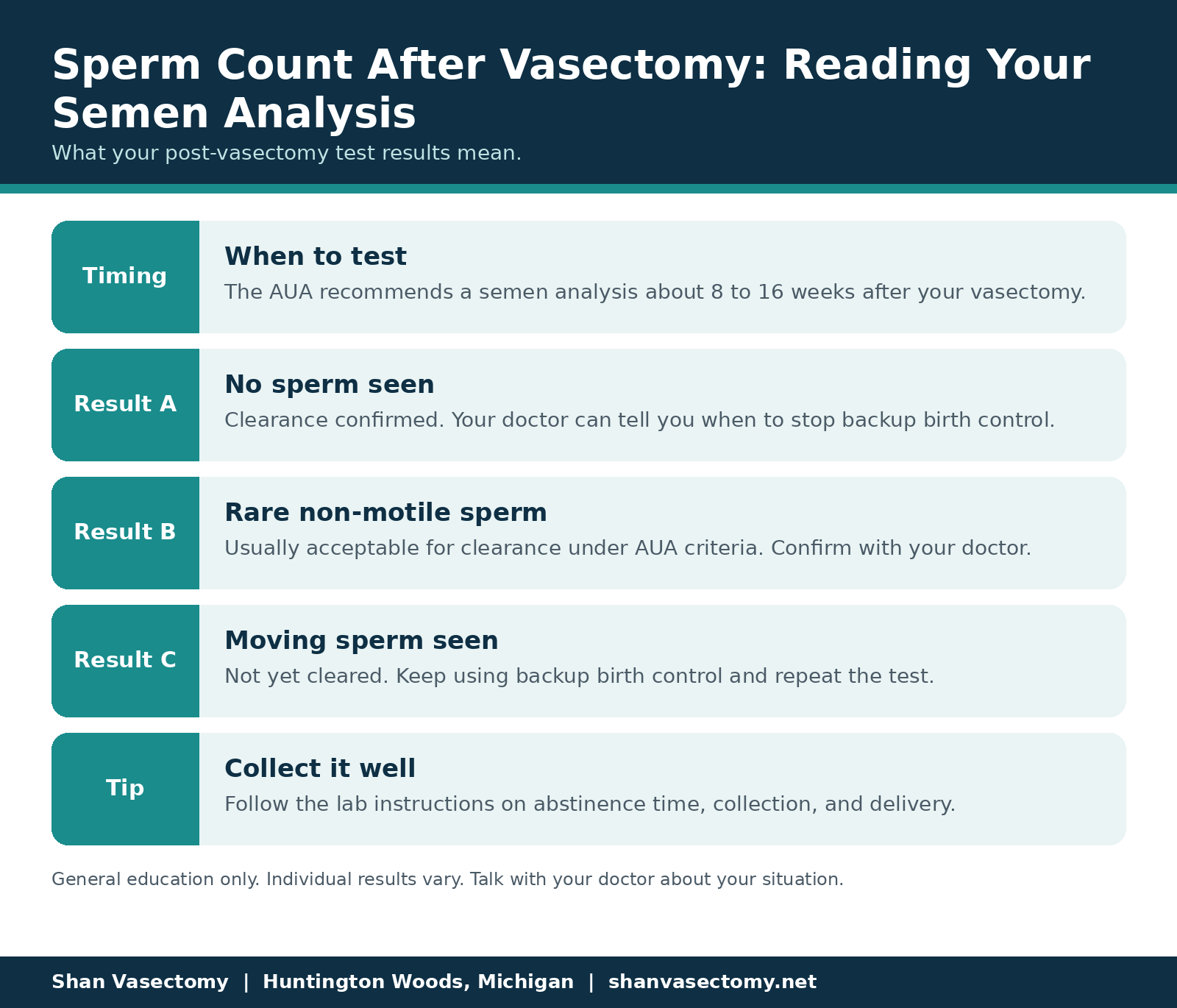
Reports on sperm count after vasectomy can look technical, but the result usually falls into one of three categories.
| Result | What It Means | Next Step
|
| No sperm seen (azoospermia) | Clearance confirmed | Stop backup birth control once your doctor confirms |
| Rare non-motile sperm (≤100,000/mL) | Meets AUA clearance criteria | Your doctor decides whether you’re cleared |
| Motile sperm, or higher counts | Not yet cleared | Keep backup birth control and repeat the test |
No Sperm Seen (Azoospermia)
This is the result everyone hopes for. The lab found no sperm in the sample. Once your doctor reviews it and confirms, you can rely on your vasectomy as birth control.
Rare Non-Motile Sperm
Sometimes a few sperm are seen, but none of them are moving. The AUA considers this acceptable when the count is no more than 100,000 non-motile sperm per milliliter. Your doctor will tell you whether your specific result qualifies, so don’t stop backup birth control on your own.
Motile Sperm Present
If any sperm are swimming, you’re not cleared yet. This is common at early tests and usually means more time is needed. If motile sperm persist after about six months, the AUA notes that a repeat vasectomy may be considered. You can read more about how often that happens in our article on vasectomy success rate.
How Do You Collect a Good Sample?
A careful collection helps you get an accurate reading of your sperm count after vasectomy the first time.
- Follow the abstinence window you’re given, usually a few days without ejaculation.
- Collect the full sample by masturbation into the sterile container provided.
- Don’t use lubricant, saliva, or a regular condom, since these can affect results.
- Label the container exactly as instructed.
- Deliver the sample within the time limit the lab specifies, keeping it near body temperature.
If you have questions about ejaculating during recovery, our article on masturbation after a vasectomy covers safe timing.
What If Your Test Still Shows Sperm?
Don’t panic. A sperm count after vasectomy that still shows sperm at three months usually means you need more time, not that the vasectomy failed. Keep using backup birth control, keep ejaculating regularly, and repeat the test when advised.
If motile sperm continue after several months, we’ll discuss next steps with you. That may include another test or, in uncommon cases, a repeat procedure.
Lab Tests vs. At-Home Tests: What’s the Difference?
Lab semen analysis looks at the sample under a microscope, which allows a technician to judge both the number of sperm and whether they move. That’s what the AUA criteria are based on.
At-home kits are convenient, but they vary in what they measure. Some only detect whether sperm are present above a certain level, and some can’t assess motility. If you’re considering a home test, check whether it meets your doctor’s clearance criteria and ask us before relying on it.
When Can You Stop Using Birth Control?
Only after your doctor reviews a qualifying result and confirms you’re cleared. Counting weeks or ejaculations isn’t enough on its own. Your sperm count after vasectomy is the only reliable measure, and the decision to stop backup protection should be based on that lab result.
For the complete fertility timeline, read about when you’re sterile after a vasectomy.
Sperm Count After Vasectomy FAQs
What Sperm Count Is Normal After a Vasectomy?
The goal is zero sperm, called azoospermia. The American Urological Association also accepts rare non-motile sperm, no more than 100,000 per milliliter, as clearance. Your doctor reviews your report and confirms whether your result qualifies before you stop backup birth control.
How Long After a Vasectomy Is Sperm Count Zero?
It usually takes several weeks to a few months for stored sperm to clear. The AUA recommends testing between 8 and 16 weeks after the procedure, and our clinic tests at about three months. Some men need longer and a repeat test.
Can I Stop Birth Control If My Test Shows Rare Non-Motile Sperm?
Only if your doctor confirms clearance. Rare non-motile sperm can meet AUA criteria, but the decision depends on the exact count and the lab’s findings. Keep using backup birth control until your doctor tells you it’s safe to stop.
How Many Ejaculations Does It Take to Clear Sperm?
There’s no reliable number. Men clear stored sperm at different rates, so counting ejaculations can’t confirm you’re sterile. Regular ejaculation helps the process, but your semen analysis result is what tells you when you’re cleared.
Are At-Home Vasectomy Tests Accurate?
They can be useful, but they vary. Some detect sperm only above a set level, and many can’t check motility, which is part of the AUA clearance criteria. Ask your doctor before relying on an at-home result to stop other birth control.
What If My Semen Test Still Shows Sperm?
Keep using backup birth control and plan a repeat test. Most men who still have sperm at an early test simply need more time. If motile sperm persist for several months, your doctor may discuss a repeat vasectomy.
The Lab Result Is the Finish Line
Checking your sperm count after vasectomy is the step that turns a completed procedure into reliable birth control. Test at the recommended time, collect your sample carefully, and wait for your doctor to confirm the result before changing anything.
It’s a small amount of effort for lasting peace of mind. If you have questions about what happens before you’re cleared, read more about pregnancy risk after a vasectomy.
Planning your procedure and want testing explained in person? Book a consultation with Dr. Shan, and we’ll walk you through every step from procedure day to clearance.
Medical disclaimer: This article is for general education and isn’t a substitute for personal medical advice. Please speak with a qualified physician about your specific health needs.
Sources
- American Urological Association. Vasectomy Guideline. https://www.auanet.org/guidelines-and-quality/guidelines/vasectomy-guideline
- Cleveland Clinic. Vasectomy: Procedure, Recovery and Effectiveness. https://my.clevelandclinic.org/health/procedures/4423-vasectomy
- Vasectomy (male sterilisation): Recovery. https://www.nhs.uk/contraception/methods-of-contraception/vasectomy-male-sterilisation/recovery/
- MedlinePlus, U.S. National Library of Medicine. Vasectomy. https://medlineplus.gov/ency/article/002995.htm


One Comment