

Yes, it is technically possible, and understanding when and why matters just as much as the answer itself. Can you get pregnant after a vasectomy?
In the vast majority of cases, no, once the procedure has been confirmed effective through testing. But there is a window early on, and a small ongoing risk later, that every patient should understand clearly before relying on this method alone.
Why Pregnancy Is Still Possible in the Weeks After Your Procedure
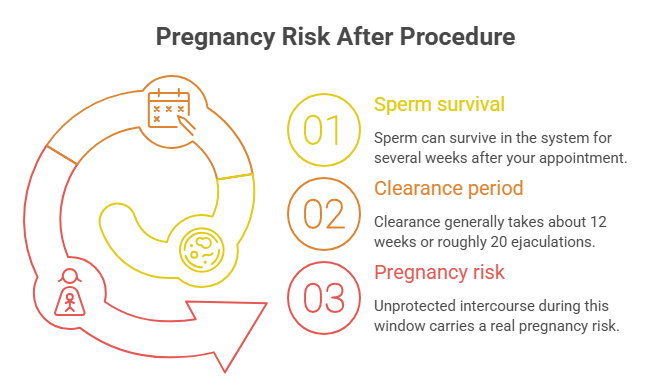
A vasectomy blocks new sperm from entering your semen, but it does not clear out sperm that was already stored in your reproductive tract before the procedure. This leftover supply is exactly why pregnancy remains possible in the immediate aftermath.
- Sperm can survive in the system for several weeks after your appointment.
- Clearance generally takes about 12 weeks or roughly 20 ejaculations.
- Unprotected intercourse during this window carries a real pregnancy risk.
This is the single most important detail for any newly vasectomized man to understand, since assuming protection starts on procedure day is the most common mistake we see.
The Role of Backup Contraception During Recovery
Because sperm clearance takes time, backup birth control is not optional during the early weeks. Condoms, birth control pills, or another reliable method should stay in place until your semen test confirms your count has dropped to zero or a clinically safe level.
Skipping this step, even once, is how pregnancies after a supposedly successful vasectomy tend to happen. Dr. Thulasi Shanmukanathan walks through this timeline at your consultation so there is no ambiguity about when it is safe to stop.
Can You Get Pregnant After a Vasectomy Once Testing Confirms Clearance
Once your semen sample comes back clear, the picture changes considerably. At that point, a vasectomy is close to 99 percent effective, making unintended pregnancy quite rare. This is why the testing step matters so much.
A clear result is your green light to rely on the procedure fully, while skipping it leaves you guessing about your actual protection level.
Why the Semen Test Is Not Optional
The post-vasectomy semen analysis, or PVSA, is the only reliable way to confirm your vasectomy worked. Without it, there is no way to know for certain whether your sperm count has cleared.
You can learn more about how this test fits into your recovery and follow the full post-procedure timeline from the days immediately after the procedure onward.
What Happens If Your First Test Is Not Clear
A first test that still shows sperm present is not necessarily cause for alarm. It usually means clearance is taking a bit longer than average, which happens for a range of reasons tied to individual biology.
In these cases, a repeat test is scheduled after a few more weeks, and backup contraception simply continues in the meantime.
This is also why questions like “Can you get pregnant after a vasectomy?” are important to discuss until testing confirms clearance. Persistent results beyond a reasonable stretch are uncommon but worth discussing directly with your physician.
Recanalization and the Small Long-Term Risk
Even after a confirmed clear result, a very small risk remains years down the line through a process called recanalization, where the divided ends of the tube reconnect on their own.
This is rare, affecting a small fraction of patients, but it explains why no form of sterilization, surgical or otherwise, carries a guaranteed zero percent failure rate over a lifetime.
| Timing | Pregnancy Risk Level | What Protects You |
| First few weeks after procedure | Real risk, sperm still present | Backup contraception required |
| After a clear semen test | Very low, about 1% | Confirmed clearance |
| Years later, rare cases | Extremely low | No further action typically needed |
Signs That Warrant a Conversation with Your Physician
While rare, certain situations are worth bringing up rather than assuming everything is fine. If a pregnancy occurs after a confirmed clear test, or if you experience unusual symptoms like new lumps, persistent pain, or swelling long after your initial recovery, reach out promptly.
These situations are uncommon, but addressing them early keeps small concerns from becoming bigger ones. You can also review helpful information about common concerns before your procedure.
Setting Realistic Expectations Before Your Procedure
Understanding that a vasectomy is highly effective, not absolutely foolproof, helps you make an informed decision instead of an overconfident one.
This is also why the procedure is considered permanent birth control rather than something to rely on immediately or without follow-through. Taking the testing step seriously is what turns a good procedure into a fully reliable one.
Get Clear Answers Before You Rely on It
So can you get pregnant after a vasectomy? Early on, yes, until testing confirms otherwise, and in rare cases years later. Understanding this timeline is what makes the difference between assuming you are protected and knowing it.
If you want to talk through the testing process or anything else on your mind, contact Dr. Thulasi Shanmukanathan and schedule a consultation with her to get clarity before your procedure.
FAQs
Can you get pregnant after a vasectomy if you skip the semen test?
Yes, without a clear test result, there is no confirmation that your sperm count has dropped, so risk remains uncertain.
How long should backup birth control be used after the procedure?
Continue using backup contraception until your semen test confirms a clear or safe sperm count, usually around the 12-week mark.
Is pregnancy possible years after a confirmed successful vasectomy?
It is extremely rare but technically possible through recanalization, where the blocked tubes reconnect on their own over time.
What if my partner gets pregnant after my vasectomy is confirmed clear?
This is uncommon, but it is worth contacting your physician promptly to discuss and rule out rare causes like recanalization.
Does the $600 fee include the semen testing kit?
No, the PVSA kit is a separate cost from the procedure fee, though HSA or FSA funds can often be used to cover it.