


By Dr. Thulasi Shanmukanathan, Board-Certified Family Physician. Medically reviewed by Dr. Thulasi Shanmukanathan | Last reviewed: November 2026
Most men who book a consultation with us ask some version of the same question: “Will this actually work?” It’s a fair thing to want to know before committing to permanent birth control. The short version is that vasectomy is one of the most reliable forms of contraception available, but the number only means something once you understand how success is measured.
In this article, we walk through the vasectomy success rate in plain language. You’ll learn what “success” really means, why the procedure isn’t effective right away, how rare failures happen, and the simple steps that keep your results on track for good.
Vasectomy Success Rate at a Glance
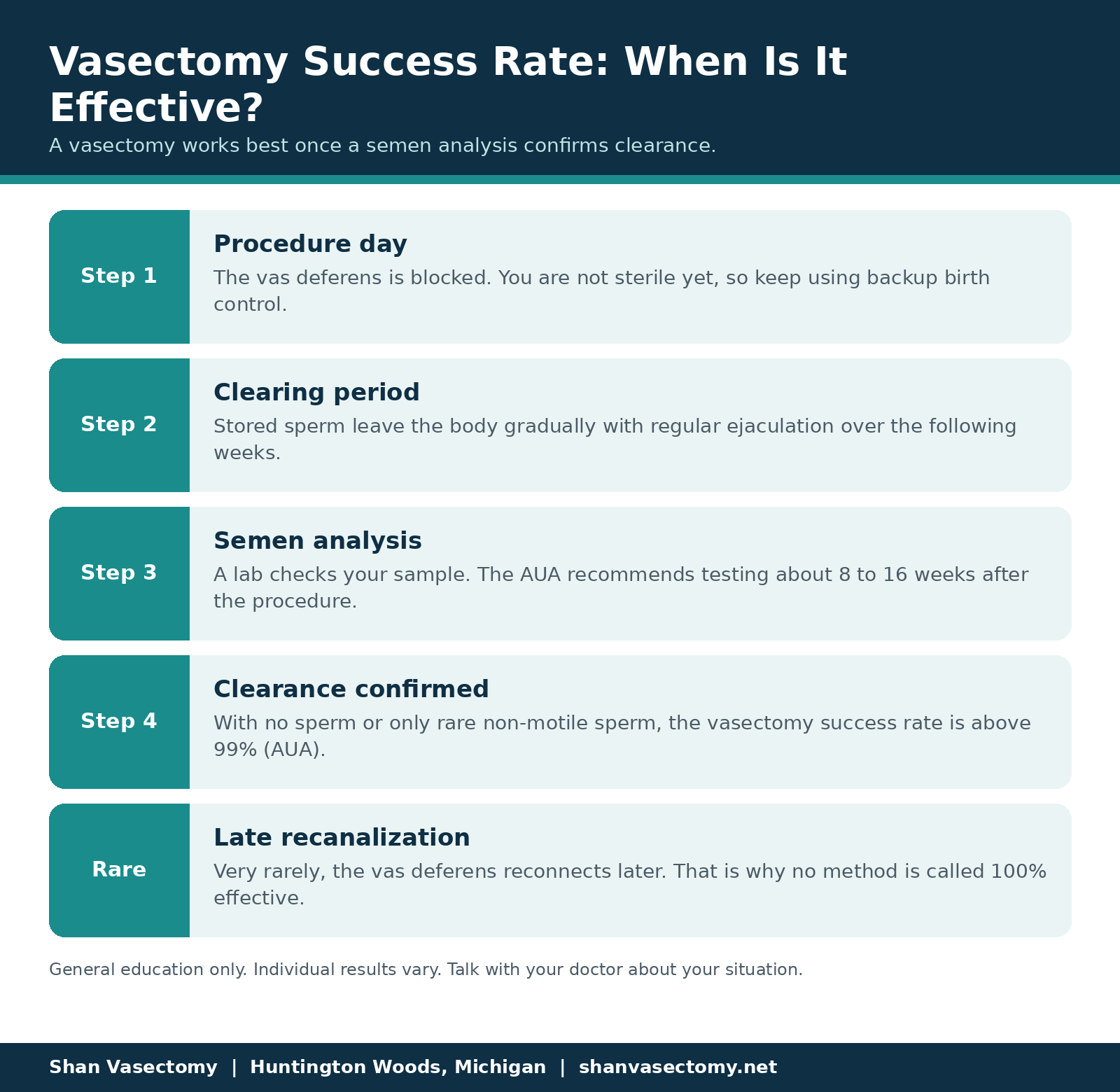
The vasectomy success rate is above 99% once a semen analysis confirms no sperm, or only rare non-motile sperm. The American Urological Association puts the pregnancy risk after clearance at roughly 1 in 2,000. Until that test confirms clearance, the procedure isn’t considered effective, so backup birth control stays essential.
That last point matters more than any statistic. A vasectomy blocks the vas deferens, but sperm already stored further along the tract can remain for weeks. We cover how a vasectomy works and when it takes effect in more depth elsewhere, but the takeaway is simple: the result is confirmed by a lab, not by the calendar.
What Does “Success” Actually Mean After a Vasectomy?
In clinical terms, a successful vasectomy is one where a post-vasectomy semen analysis shows zero sperm (azoospermia) or a very small number of sperm that can’t move. Finishing the procedure is step one. Confirmed sterility is the real finish line.
Procedure Completed vs. Sterility Confirmed
When you leave our office, both sides of the vas deferens have been sealed and the procedure is complete. You aren’t sterile yet, though. Sperm already sitting above the blockage, in the upper vas and the ejaculatory ducts, still has to clear out over the following weeks.
For that reason, your personal vasectomy success rate is only confirmed when your semen sample passes the criteria set out in the AUA vasectomy guideline. That’s why we treat the follow-up test as part of the procedure rather than an optional extra.
Why a Vasectomy Isn’t Effective Immediately
Think of it like turning off a tap. The water stops flowing in, but some is still in the pipe. It usually takes a number of ejaculations and a few months for leftover sperm to clear, which is why we schedule a semen analysis at about three months.
The semen test results explained guide covers sample collection and what each result category means, so we keep this summary short here.
How Common Is Vasectomy Failure? Early vs. Late Failure
Failure is uncommon, and when it happens, it usually falls into one of two buckets. Knowing the difference helps you understand why testing matters so much.
Early Failure (Residual or Persistent Sperm)
Early failure means motile sperm are still present on semen testing months after the procedure. According to the AUA guideline, persistent motile sperm beyond about six months is uncommon and may mean the vas deferens has reconnected or wasn’t fully blocked. In that case, a repeat vasectomy is sometimes recommended.
This type of failure is caught by testing before it can lead to pregnancy, provided you keep using backup contraception until you’re cleared.
Late Failure (Recanalization)
Late failure happens when the two cut ends of the vas deferens slowly form a tiny new channel after clearance has already been confirmed. This is called late recanalization. It’s rare, and the roughly 1-in-2,000 pregnancy figure cited by the AUA reflects this kind of event.
We don’t share this to worry anyone. It simply explains why no form of contraception, including vasectomy, is described as 100% effective.
What Affects Your Vasectomy Success Rate?
A few factors influence how reliably the procedure works. Some are in the doctor’s hands, and one important factor is entirely in yours.
Technique: No-Scalpel, Cautery, and Fascial Interposition
The no-scalpel approach uses a single small puncture instead of an incision. Research summarized by the AUA links it with fewer complications such as bleeding and infection, while effectiveness depends on how the vas deferens is sealed. Methods such as cautery of the inner lining and placing a layer of tissue between the cut ends (fascial interposition) are associated with lower failure rates.
At our Michigan clinic, Dr. Shan performs a no-scalpel vasectomy paired with needle-free MadaJet anesthesia, and she explains her sealing method at your consultation.
Surgeon Experience and Procedure Volume
Experience matters in any procedure that relies on precise technique. Dr. Shan has performed over 900 vasectomies and focuses her procedure days on this one operation. You can read more about Dr. Shan’s experience with 900+ procedures and her training.
Following the Semen-Test Protocol
This is the biggest factor you control. Most unplanned pregnancies linked to vasectomy happen because a couple stopped using backup contraception before a semen analysis confirmed clearance. Completing your test and waiting for the result protects your vasectomy success rate more than anything else.
How Does Vasectomy Compare With Other Birth Control?
Vasectomy sits alongside implants and IUDs as one of the most effective methods available. The figures below come from the Centers for Disease Control and Prevention’s typical-use estimates.
| Method | Pregnancies per 100 People in the First Year (Typical Use) | Permanent?
|
| Vasectomy | 0.15 | Yes |
| Tubal surgery | 0.5 | Yes |
| Hormonal implant | 0.1 | No |
| IUD (hormonal or copper) | 0.1–0.8 | No |
| Pill, patch, or ring | 7 | No |
| External (male) condom | 13 | No |
Vasectomy also tends to be simpler and quicker to recover from than tubal surgery. If you and your partner are weighing both options, our breakdown of vasectomy vs. tubal ligation compares cost, recovery, and risks side by side.
How Semen Testing Confirms Your Result
At about three months, you’ll provide a semen sample for analysis. The lab checks for sperm and whether any sperm present can move. If the sample shows no sperm, or only rare non-motile sperm within guideline limits, you’re cleared to stop backup birth control.
That single test turns a completed procedure into a confirmed result. It’s quick and private, and it’s the step that makes the vasectomy success rate figures meaningful for you personally.
What Should You Do If Sperm Is Still Present?
First, don’t panic. A test that still shows sperm at three months doesn’t mean the vasectomy failed. Many men simply need more time and more ejaculations to clear the remaining sperm.
Keep using backup contraception, and plan on a repeat test as directed. If motile sperm persist over several months, we’ll discuss next steps, which may include a repeat procedure. For couples worried about timing, our explainer on pregnancy risk after a vasectomy covers what’s realistic and what isn’t.
How Our Clinic Protects Your Results
We built our process around reducing every avoidable cause of failure. At your consultation, Dr. Shan reviews your history, explains the no-scalpel technique, and makes sure you understand the testing timeline before anything is scheduled.
After your procedure, we give you clear written aftercare instructions and remind you about the three-month semen analysis. Our all-inclusive fee covers the consultation, the procedure, and follow-up care if needed, so cost never becomes a reason to skip a step.
Vasectomy Success Rate FAQs
What Is the Success Rate of a Vasectomy?
Once semen testing confirms clearance, a vasectomy is more than 99% effective. The American Urological Association estimates the pregnancy risk after clearance at about 1 in 2,000. Before that test, it shouldn’t be relied on, so keep using another form of birth control until you’re cleared.
Is a Vasectomy 100% Effective?
No form of birth control is 100% effective, and vasectomy is no exception. Rarely, the vas deferens reconnects on its own through recanalization. Even so, vasectomy has one of the lowest pregnancy rates of any method, below tubal surgery and comparable to hormonal implants and IUDs.
How Long Until a Vasectomy Is Effective?
A vasectomy isn’t effective right away. Sperm stored beyond the blocked section needs time and ejaculations to clear. We test at about three months, and you’re considered sterile only after a semen analysis confirms no sperm or rare non-motile sperm.
What Is the Most Common Reason a Vasectomy Fails?
The most common cause of pregnancy after a vasectomy is stopping backup contraception before a semen test confirms clearance. The main biological cause is recanalization, where the cut ends of the vas deferens form a small new channel. Both risks are minimized by completing your follow-up testing.
Does a No-Scalpel Vasectomy Have a Different Success Rate?
The no-scalpel technique changes how the vas deferens is reached, not how it’s sealed, so effectiveness is comparable to traditional methods. What it does improve is comfort. It’s linked with less bleeding, fewer infections, and a quicker recovery, which is why we use it for every patient.
Can a Vasectomy Fail After 10 Years?
It’s possible but very rare. Late recanalization can occur years after clearance, which is reflected in the roughly 1-in-2,000 pregnancy estimate. If a partner ever becomes pregnant unexpectedly, a repeat semen analysis is a simple way to check your status.
Confidence Comes From Confirmation
A vasectomy is one of the most dependable choices you can make for permanent birth control, but its reliability rests on two things working together. The first is a precise procedure performed by an experienced doctor. The second is a semen analysis that confirms the result before you stop other contraception.
When both are in place, your odds of an unplanned pregnancy drop to among the lowest of any method available. If you have questions about your own situation, we’re always happy to talk them through before you decide.
Ready to take the next step with a doctor who’s done this hundreds of times? Book a consultation with Dr. Shan at our Huntington Woods clinic and get every question about results answered before your procedure.
Medical disclaimer: This article is for general education and isn’t a substitute for personal medical advice. Please speak with a qualified physician about your specific health needs.


One Comment