


By Dr. Thulasi Shanmukanathan, Board-Certified Family Physician. Medically reviewed by Dr. Thulasi Shanmukanathan
It’s surprisingly common for men to worry that a vasectomy is a form of castration. Jokes and old myths don’t help. When we explain the difference at consultation, the relief on patients’ faces is usually immediate.
The vasectomy vs castration comparison is simple once you see what each procedure does. One blocks a small tube that carries sperm. The other removes or shuts down the testicles. In this article, we lay out the differences in plain terms, including hormones, recovery, reversibility, and purpose.
Vasectomy vs. Castration: Is a Vasectomy Castration?
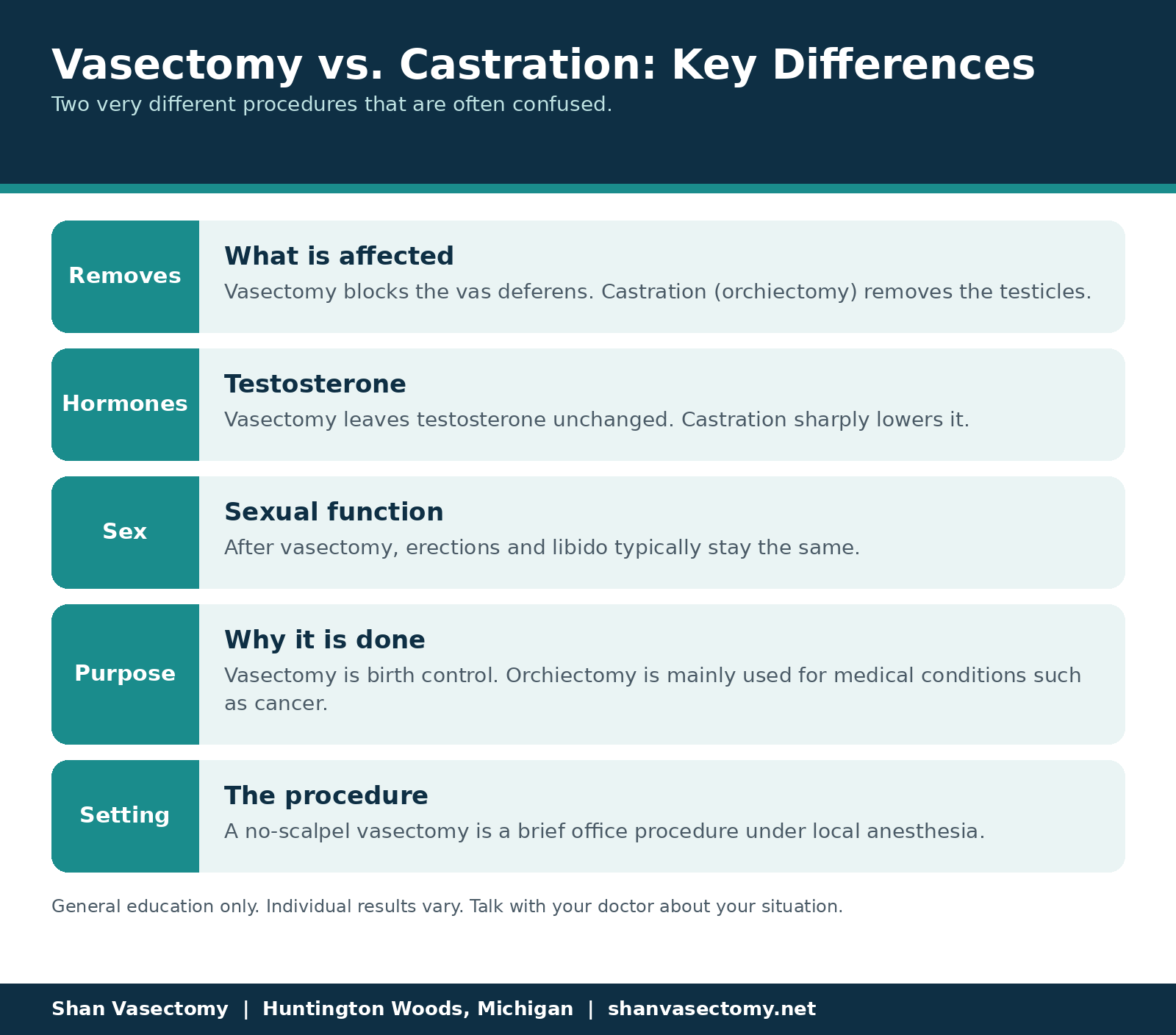
A vasectomy blocks the vas deferens so sperm can’t reach semen, while the testicles stay in place and keep making testosterone. Castration removes the testicles or stops their hormone production.
A vasectomy doesn’t change hormones, erections, or sex drive. Castration significantly lowers testosterone and is usually done for medical reasons.
What Is a Vasectomy?
A vasectomy is a minor outpatient procedure that seals each vas deferens, the tubes that carry sperm from the testicles. The testicles aren’t removed or altered, and the procedure is used only as permanent birth control. Learn more on our page explaining what is a vasectomy.
What Is Castration (Orchiectomy)?
In medical terms, surgical castration is called an orchiectomy, which means removing one or both testicles. Doctors may recommend it to treat testicular cancer or to lower testosterone as part of treatment for advanced prostate cancer, according to MD Anderson Cancer Center.
Removing one testicle often leaves hormone levels near normal, since the remaining testicle can compensate. Removing both causes a sharp drop in testosterone, which is the intended effect in some cancer treatments.
How Do They Compare Side by Side? Vasectomy vs Orchiectomy
| Factor | Vasectomy | Castration (Bilateral Orchiectomy)
|
| What’s changed | Vas deferens sealed | Both testicles removed |
| Testosterone | Unchanged | Drops sharply |
| Sperm production | Continues; sperm reabsorbed | Stops |
| Ejaculation | Continues, without sperm | Usually reduced; semen volume and sexual function often affected |
| Reversibility | Sometimes reversible with surgery | Not reversible |
| Recovery | About a week for most men | Longer surgical recovery |
| Typical purpose | Permanent birth control | Cancer treatment or other medical reasons |
| Anesthesia | Local | Often general or spinal |
The vasectomy vs castration table makes the core point clear: these are entirely different procedures with different goals.
Why Vasectomy Doesn’t Change Testosterone?
Testosterone is made in the testicles and travels through the bloodstream, not through the vas deferens. Sealing the vas deferens doesn’t touch the blood supply or the hormone-producing cells. An early study on the endocrine effects of vasectomy found no meaningful change in hormone levels, and later research has supported that finding.
That’s why men keep the same energy, muscle, voice, and sex drive after a vasectomy. For more on desire and performance, see our article on vasectomy and sexual function.
What Are the Most Common Myths?
Many myths come from blurring the vasectomy vs castration line. Here are two we hear often.
“It Makes You Less of a Man”
A vasectomy doesn’t remove anything that defines masculinity. Your testicles, hormones, erections, and orgasms stay the same. Many men actually report feeling more relaxed about sex once pregnancy worry is gone.
“It Changes Your Voice or Muscle”
Voice, muscle mass, and body hair depend on testosterone. Since a vasectomy doesn’t affect testosterone, these don’t change. The only difference is that your semen no longer carries sperm after clearance.
What’s the Difference Between Surgical and Chemical Castration?
Surgical castration removes the testicles. Chemical castration uses medication to suppress testosterone production without surgery. It’s most often used in prostate cancer care and is usually reversible when the medication stops, although effects can take time to wear off. Neither is related to a vasectomy in any way.
What About Vasectomy vs. Neutering in Pets?
Pet owners sometimes use these words loosely, which adds to the vasectomy vs castration mix-up. Neutering a male dog or cat usually means removing the testicles, which is castration. A pet “vasectomy” is a different procedure that leaves the testicles in place, much like in humans.
So when people joke that a vasectomy is like “getting neutered,” it’s not accurate. Human vasectomy keeps the testicles and hormones intact.
Is a Vasectomy Right for You?
If the vasectomy vs castration confusion was the thing holding you back, we hope this clears it up. A vasectomy is a quick, low-risk procedure that leaves your hormones and sexual function alone. If you’re weighing the decision more broadly, our article should I get a vasectomy can help you think it through.
Vasectomy vs Castration FAQs
Is a Vasectomy the Same as Castration?
No. A vasectomy seals the tubes that carry sperm, while the testicles remain and keep working normally. Castration removes the testicles or shuts down their hormone production. They’re different procedures with different purposes, and a vasectomy doesn’t affect testosterone or sexual function.
Does a Vasectomy Lower Testosterone?
No. Testosterone is produced in the testicles and released into the bloodstream, and a vasectomy doesn’t affect either. Studies have found no meaningful change in hormone levels after a vasectomy.
What Are the Main Differences Between a Vasectomy and Castration?
A vasectomy blocks sperm and is used for birth control, while hormones and sexual function stay the same. Castration removes the testicles, lowers testosterone sharply, and is typically done to treat cancer. The side-by-side table above summarizes each difference.
Is Castration Reversible?
Surgical castration isn’t reversible, because the testicles are removed. Chemical castration with medication is usually reversible once treatment stops. By contrast, a vasectomy can sometimes be reversed with microsurgery, though it’s best to treat it as permanent.
Does a Vasectomy Change Your Voice or Appearance?
No. Voice, muscle, body hair, and energy depend on testosterone, which a vasectomy doesn’t change. You’ll look, sound, and feel the same. The only change is that your semen no longer contains sperm once a semen analysis confirms clearance.
What Is the Difference Between Surgical and Chemical Castration?
Surgical castration removes the testicles through an operation. Chemical castration uses medication to suppress testosterone without surgery, and its effects usually reverse when the medication stops. Both are mainly used to treat hormone-sensitive cancers, not for birth control.
Clearing Up the Confusion
The vasectomy vs castration question comes down to one key fact: a vasectomy leaves your testicles and hormones exactly as they are. It’s a targeted procedure that blocks sperm and nothing more, while castration is a separate medical treatment with very different effects.
If you have more questions about what a vasectomy will and won’t change, we’re glad to answer them in person. Book a consultation with Dr. Shan for straight answers in a private, comfortable setting.
Medical disclaimer: This article is for general education and isn’t a substitute for personal medical advice. Please speak with a qualified physician about your specific health needs.


One Comment