

By Dr. Thulasi Shanmukanathan, Board-Certified Family Physician. Medically reviewed by Dr. Thulasi Shanmukanathan
Some men who are almost sure about a vasectomy still want a backup plan. Freezing sperm before a vasectomy can offer that peace of mind, and one of the first questions people ask is how long can sperm be frozen before it’s no longer useful.
The good thing is that frozen sperm can last a very long time. In this article, we explain how sperm freezing works, the real limits on storage, what affects quality after thawing, and how to decide whether banking makes sense before your vasectomy.
How Long Can Sperm Be Frozen?
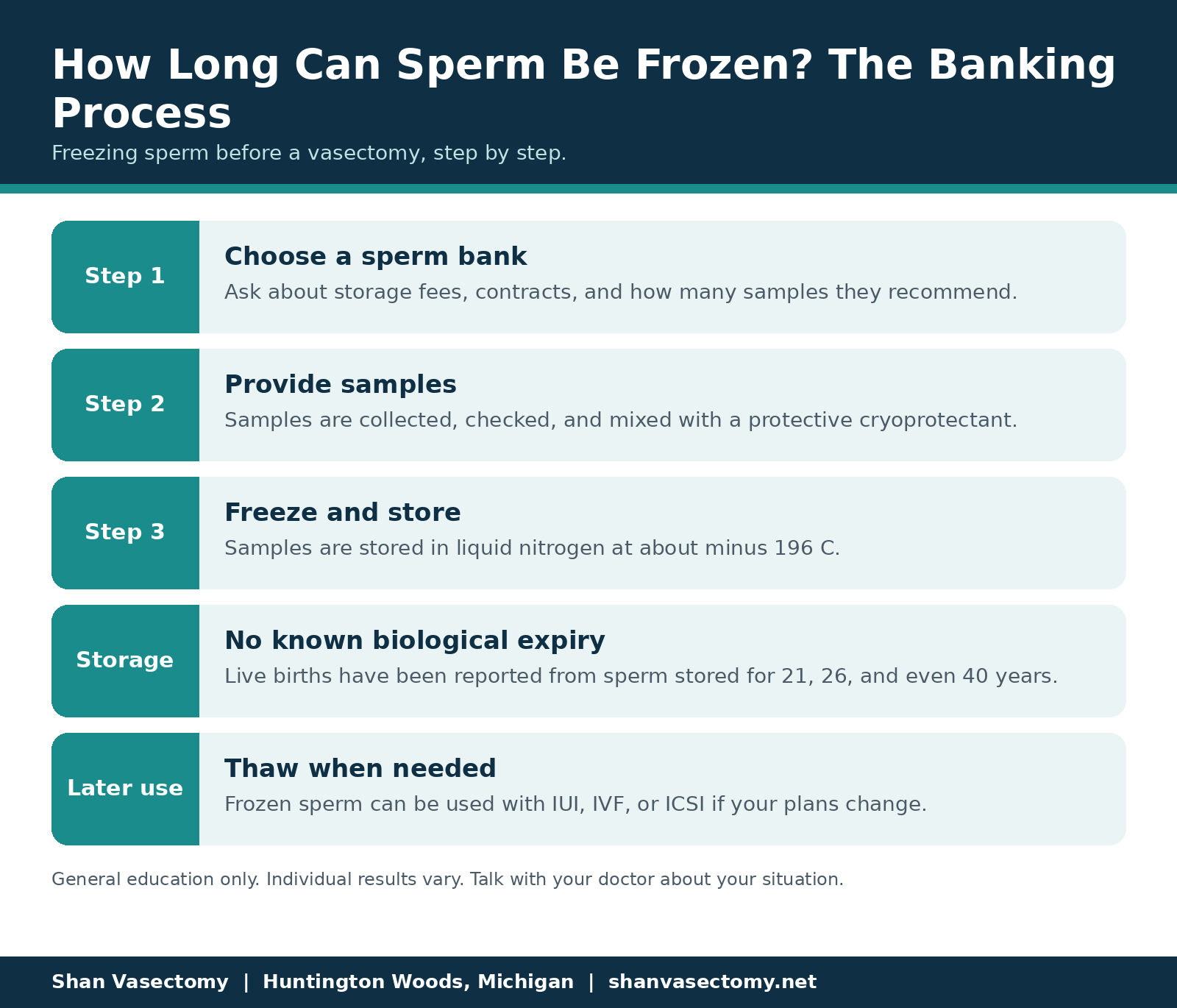
When it’s stored properly in liquid nitrogen, sperm can stay viable for decades and possibly indefinitely. A documented live birth has occurred from sperm stored for 40 years. In practice, storage limits usually come from sperm bank policies, contracts, and local regulations rather than from biology.
How Does Sperm Freezing (Cryopreservation) Work?
For sperm cryopreservation, a semen sample is collected, usually by masturbation at the bank or clinic. The lab analyzes it, mixes it with a protective solution called a cryoprotectant, and divides it into small vials or straws.
The samples are then cooled gradually and stored in liquid nitrogen at about -196°C. At that temperature, biological activity essentially stops. That’s why the question of how long can sperm be stored or frozen has such a reassuring answer.
What Limits Storage in Terms of Biology, Policy, or Contract?
When people ask how long can sperm be frozen, they’re often mixing up three different kinds of “limits.” It helps to separate them.
What Is the Scientific Limit?
There’s no known biological expiry date for properly frozen sperm. Researchers reported live births from frozen semen stored for 40 years, and a separate case report described a live birth after 21 years of storage. The main risk is equipment failure, not time itself.
How Do Bank and Clinic Policies and Fees Work?
Most sperm banks charge an initial fee for collection, testing, and freezing, plus an ongoing storage fee, often billed annually. Some set maximum storage periods or require you to renew your agreement. Read the contract carefully, and ask what happens if a payment is missed.
What About Consent and Legal Considerations?
Storage agreements usually ask what should happen to your samples if you die, become incapacitated, or stop paying. Rules vary by location and facility, so check with the bank and, if needed, a licensed legal professional. We can’t give legal advice, but we encourage you to settle these choices in writing.
Does Frozen Sperm Quality Decline?
Knowing how long can sperm be frozen is only half the picture; quality matters too. The freezing and thawing process is the main source of loss, not the years in storage. Some sperm don’t survive thawing, and motility (how well sperm swim) often drops after thawing. That’s why labs typically store several vials from each sample.
Once frozen, quality appears to stay stable for long periods. A case report of autologous frozen sperm used after 26 years adds to the evidence that time in storage has little effect when conditions are maintained.
Should You Freeze Sperm Before a Vasectomy?
Banking sperm isn’t necessary for most of our patients. For some men, it’s a sensible safety net.
Who Should Consider It?
You might consider freezing sperm if you’re younger, don’t have children yet, have any doubt about future plans, or simply want insurance against unexpected life changes. Banking can also make sense if you’d prefer not to rely on a reversal later. If you’re still deciding, our article should I get a vasectomy offers a helpful framework.
How Many Samples Are Typical?
It depends on your sperm quality and how many future pregnancies you might want. Banks often recommend more than one sample, collected on separate days, to store enough vials. Ask the bank for a recommendation based on your semen analysis.
What Does Sperm Banking Cost?
Costs vary widely by bank and region. Expect an upfront fee for collection, screening, and freezing, plus yearly storage fees. Future use adds the cost of fertility treatment. Ask several banks for written quotes, since prices change and we don’t want to quote figures that may be out of date.
How Is Stored Sperm Used Later: IUI, IVF, or ICSI?
Thawed sperm can be used in a few ways. Intrauterine insemination (IUI) places sperm directly in the uterus. In vitro fertilization (IVF) combines sperm and eggs in a lab. With intracytoplasmic sperm injection (ICSI), a single sperm is injected into each egg, which works well when sperm numbers or motility are lower after thawing.
A fertility specialist will recommend the best approach based on your sample quality and your partner’s health. If you’re weighing every route to future children, see our overview of fertility after a vasectomy.
How Does Sperm Banking Compare With Vasectomy Reversal?
| Factor | Sperm Banking (Before Vasectomy) | Vasectomy Reversal (After)
|
| When it’s done | Before your vasectomy | Any time after |
| Procedure | Sample collection, no surgery | Microsurgery, often under general anesthesia |
| Ongoing costs | Annual storage fees | One-time surgery fee |
| Path to pregnancy | IUI, IVF, or ICSI | Often natural conception if successful |
| Effect of time | Stored sperm stays stable | Success tends to decline as years pass, per Mayo Clinic |
How Do You Choose a Sperm Bank?
Look for a bank that’s accredited and transparent. Consider these points:
- Accreditation and regulatory compliance.
- Clear pricing for freezing, storage, and release of samples.
- Backup systems for power and liquid nitrogen monitoring.
- Written policies for long-term storage, transfer, and disposal.
- A recommended number of samples based on your analysis.
Frequently Asked Questions
How Long Can Sperm Be Frozen?
Properly frozen sperm can last for decades and possibly indefinitely. Live births have been reported from sperm stored for 40 years. In practice, how long sperm stays in storage depends more on bank policies, contracts, and local rules than on any biological limit.
Does Freezing Damage Sperm?
Freezing and thawing do cause some loss. Some sperm don’t survive, and motility often decreases after thawing. Labs account for this by storing several vials. Once frozen, though, sperm quality remains largely stable over long periods when conditions are maintained.
Should I Freeze Sperm Before a Vasectomy?
It’s worth considering if you’re younger, don’t have children, or feel any uncertainty about the future. Many men don’t need it, but for some it provides valuable peace of mind. Talk with your doctor and a sperm bank about whether it fits your plans.
How Much Does Sperm Banking Cost?
Costs vary by bank and location. Most charge an initial fee for collection, testing, and freezing, plus annual storage fees. Fertility treatment to use the sperm later is a separate cost. Request written quotes from a few banks to compare current prices.
Can Frozen Sperm Be Used After a Vasectomy?
Yes. Sperm banked before a vasectomy can be used later through IUI, IVF, or ICSI, depending on sample quality and your partner’s fertility. A fertility specialist will recommend the most suitable option when you’re ready to try for a pregnancy.
How Many Samples Should I Freeze?
It depends on your sperm quality and how many future pregnancies you might want. Many banks suggest more than one sample collected on separate days. Your bank can give a personal recommendation after reviewing your semen analysis results.
How Long Does Frozen Sperm Last?
Properly frozen sperm stored in liquid nitrogen at -196°C (-321°F) can last indefinitely. At this ultra-low temperature, all biological activity, metabolism, and cellular aging completely stop, essentially placing the cells in suspended animation.
A Safety Net Worth Knowing About
So, how long can sperm be frozen? For practical purposes, as long as it’s stored correctly and the agreement stays in place. For men who are confident about a vasectomy but want a backup, banking can be a reassuring step that keeps future options open.
If you’re unsure whether banking is right for you, we’re happy to talk it through. For broader background first, our vasectomy overview covers the procedure from start to finish.
Thinking about banking before your procedure? Book a consultation with Dr. Shan to plan your timing and next steps.