

If you have a busy schedule, you have probably asked yourself, “How long does a vasectomy take before you can commit to a date?”
The appointment itself is short, but the full picture includes prep time at the office, the procedure, and a recovery window that unfolds over the following weeks.
Here is a clear, hour-by-hour and day-by-day breakdown so you know exactly what to plan for.
Breaking Down Appointment Time from Start to Finish
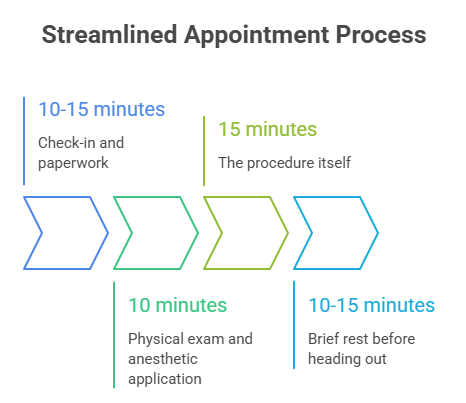
The procedure itself usually takes about 15 minutes, but your total time at the office runs a bit longer once you factor in check-in, a brief physical exam, and the numbing step before Dr. Shanmukanathan begins.
- Check-in and paperwork:10 to 15 minutes.
- Physical exam and anesthetic application:10 minutes.
- The procedure itself:about 15 minutes.
- Brief rest before heading out:10 to 15 minutes.
Altogether, most patients are in and out within an hour, which makes it easy to schedule around a half day off work rather than losing an entire afternoon.
How Long Does a Vasectomy Take Compared to Other Outpatient Procedures
Compared to many other outpatient medical procedures, a vasectomy is remarkably quick. Colonoscopies, minor surgical biopsies, and similar in-office procedures often run 30 minutes or longer once you include sedation recovery time.
Because this technique uses only a local, needle-free anesthetic and skips general sedation entirely, there is no grogginess to wait out afterward, which is part of why most men can drive themselves home the same day.
The First 24 Hours After Your Procedure
The clock does not stop once you leave the office, and the first day sets the tone for the rest of your recovery.
- Plan to rest on the couch or in bed for the remainder of the procedure day.
- Keep the initial gauze pad in place for several hours before changing it.
- Apply a cloth-wrapped ice pack for fifteen minutes at a time to manage swelling.
- Avoid any bending, lifting, or straining during this window.
Most of the discomfort during this stretch is mild, and it tends to ease noticeably by the following morning.
Days Two Through Seven of Recovery
This is the stretch where most of the healing happens quietly in the background while you gradually resume normal movement.
| Day | What You Can Typically Do |
| Day 1 | Rest, ice the area, and wear supportive underwear |
| Day 2 to 3 | Shower normally, take light walks, light desk work |
| Day 4 to 5 | Continue light activity, monitor for swelling |
| Day 6 to 7 | Prepare to resume exercise if swelling has settled |
When You Can Return to Work
For most men, returning to a desk job within two to three days feels comfortable, especially with supportive underwear and a bit of extra caution around sitting for long stretches.
Physically demanding jobs need more patience. If your work involves heavy lifting, climbing, or a lot of standing and bending, plan for closer to a full seven days off before returning, since strain during this window can slow healing or increase swelling.
When You Can Resume Workout and Physical Activity
Light walking is fine the day after your procedure, but anything more intense needs to wait. Avoid heavy lifting, running, cycling, and contact sports for a full seven days to give the puncture site time to close properly and to prevent unnecessary swelling.
Jumping back into an intense workout routine too soon is one of the more common reasons recovery takes longer than expected, so patience during this first week pays off.
When You Can Resume Sexual Activity
You can safely resume sexual activity after seven days once you feel physically comfortable doing so. Keep in mind that this timeline is about healing, not effectiveness. Sperm remains in your system for a period afterward, so backup contraception is still necessary well beyond this point.
How Long Does a Vasectomy Take to Become Fully Effective
This is the part of the timeline that surprises a lot of men. While the physical recovery wraps up within a week or two, full contraceptive effectiveness takes considerably longer.
You should continue using an alternative form of birth control until you complete a semen test, usually scheduled around the 12-week mark or after roughly 20 ejaculations, confirming your sperm count has cleared.
Details on this step and how it fits into your overall care are outlined by Dr. Thulasi Shanmukanathan during your consultation, so nothing about the process feels unclear.
Planning Your Schedule Around the Full Timeline
Knowing the time it takes for the vasectomy procedure at each stage makes it much easier to plan your week, your work commitments, and any physical activities you have coming up.
A little foresight, like scheduling your appointment before a lighter week at work or holding off on a planned hike, prevents unnecessary frustration later.
You can learn more about the technique itself and how it contributes to a shorter recovery before deciding if it is right for you.
Plan Your Procedure Date with Confidence
Now that you know how long a vasectomy takes from the appointment itself through full recovery and effectiveness, planning around your schedule should feel much more manageable.
If you want to talk through timing, work commitments, or anything else specific to your situation, schedule a consultation with Dr. Shanmukanathan now and get personalized guidance before you choose your date.
FAQs
How long does a vasectomy take from start to finish at the office?
Most appointments take about an hour total, including check-in and prep, with the procedure itself lasting around 15 minutes.
How soon can I go back to a physically demanding job?
Plan for about seven days before returning to jobs involving heavy lifting or significant physical strain.
Is the recovery timeline different for older patients?
Age generally does not significantly change the recovery timeline, though individual healing pace can vary from person to person.
When should I schedule my follow-up semen test?
Your semen test is typically scheduled around 12 weeks after your procedure or after about 20 ejaculations, whichever comes first.
Can I shorten the recovery timeline by taking more time off?
Rest helps, but healing still follows its own pace, so following the seven-day activity guidelines matters more than extra days off alone.