Categories
Uncategorized

Vasectomy Cost Michigan: $600 Flat Rate in Huntington Woods

Most men researching vasectomy cost in Michigan quickly discover that pricing is all over the map. Quotes from $400 to $1,500 are common, and very few clinics tell you upfront what that number actually includes. Hidden fees for consultations, follow-up semen analysis appointments, and facility charges have a way of turning a $500 quote into a $900 bill. At Shan Vasectomy in Huntington Woods, Michigan, the price is $600. That covers the consultation, the procedure, and all follow-up visits. No surprises. This article breaks down exactly what drives vasectomy pricing in Michigan and why that $600 flat rate represents the clearest value available in the state.

Table of Contents

Quick Takeaways

Key Insight Explanation
Shan Vasectomy charges a flat $600 This includes the consultation, procedure, and all follow-up visits. No facility fees, no hidden line items.
Michigan vasectomy prices range from $400 to $1,500 Advertised low prices often exclude consultation and post-procedure semen analysis, inflating the real total.
No-needle technique reduces recovery and procedural anxiety Dr. Shanmukanathan uses a no-scalpel, no-needle approach that minimizes discomfort and downtime compared to traditional methods.
Hospital-based vasectomies carry facility fees A vasectomy done in a hospital or outpatient surgical center adds anesthesia and facility costs that routinely push total cost past $1,000.
Vasectomy is 99.99% effective permanent contraception Over a lifetime, it costs a fraction of what hormonal contraception or other permanent methods cost, making the $600 price even more compelling.
Self-pay patients benefit most from flat-rate pricing Without insurance, the $600 all-in price at Shan Vasectomy is among the most transparent and competitive rates in southeastern Michigan.
Follow-up semen analysis is part of the package Confirming sterility after the procedure is a medical necessity. At many clinics this is an added charge. At Shan Vasectomy it is included.

What Drives Vasectomy Cost in Michigan

The price of a vasectomy in Michigan is shaped by three main variables: where the procedure is performed, who performs it, and what the quoted price actually includes. Each of those factors can swing the final cost by hundreds of dollars in either direction.

Vasectomies performed inside hospital systems or licensed outpatient surgical centers carry mandatory facility fees. Those fees exist to cover overhead, staff, equipment sterilization, and administrative costs that have nothing to do with the actual procedure. The surgeon’s fee is often a separate line item on top of that. Facility fees alone can add $300 to $600 to a bill that looked reasonable on the clinic’s website.

Specialist vs. general practice also matters. Urologists who perform vasectomies as one of dozens of procedures tend to charge more than dedicated vasectomy specialists. A specialist clinic like Shan Vasectomy that focuses exclusively on vasectomies operates with lower per-procedure overhead, and that efficiency passes directly to the patient.

Why Volume Specialization Lowers Cost Without Sacrificing Quality

A common mistake men make when comparing vasectomy prices is assuming that lower cost means lower quality care. In practice, the opposite is often true for dedicated clinics. A physician who performs vasectomies every week develops a level of procedural precision that reduces complication rates, procedure time, and the need for costly corrective follow-ups.

Dr. Thulasi Shanmukanathan at Shan Vasectomy has built a practice specifically around this model. The single-procedure focus allows for streamlined scheduling, predictable costs, and a patient experience calibrated entirely around vasectomy care rather than shoehorned into a general urology appointment slot.

Pro tip: When you call any clinic for a vasectomy price, ask specifically whether the consultation, the procedure, and the post-vasectomy semen analysis are all included in the quoted number. If any of those are billed separately, add them to the comparison.

Image is being generated...

The Hidden Fees Most Clinics Don’t Advertise

Transparent pricing is rare in healthcare, and vasectomy pricing is no exception. The data consistently shows that patients who receive a low advertised price often pay significantly more once all services are accounted for. Here is where the gaps appear most often.

Consultation Fees Billed Separately

Many urology practices require a formal consultation visit before scheduling the procedure. That visit is billed as an office visit, typically $75 to $200 depending on the provider and whether insurance applies. Some practices waive this if you proceed with booking, but that is not standard. At Shan Vasectomy, the consultation is included in the $600 flat rate. There is no separate charge for that initial visit.

Post-Vasectomy Semen Analysis

Confirming that a vasectomy worked requires a semen analysis conducted roughly 8 to 12 weeks after the procedure. This is not optional. It is the only way to verify that no viable sperm remain. Many clinics charge for this separately, adding $50 to $150 to the total. Some send patients to an outside lab, which adds another bill entirely. Shan Vasectomy includes all necessary follow-up visits in the original $600 price.

Anesthesia Add-Ons

The no-needle technique used at Shan Vasectomy delivers local anesthetic without a traditional needle injection. Traditional vasectomy clinics that use needle-based anesthesia sometimes offer sedation or anxiolytic medications as an optional add-on, typically billed separately. Knowing what method is used before you book eliminates billing surprises.

“The most expensive healthcare is healthcare with hidden costs. A $500 procedure that becomes $950 after fees is not affordable care. It is mispriced care.” – Healthcare pricing transparency advocacy, American Journal of Managed Care

No-Scalpel, No-Needle: What the Technique Difference Means for Price

The no-scalpel, no-needle vasectomy technique is not simply a marketing label. It represents a genuinely different procedural approach with clinical implications for both recovery and cost. Understanding the distinction helps men evaluate whether a price difference between providers reflects actual value or just marketing positioning.

Traditional Vasectomy vs. No-Scalpel No-Needle

Traditional vasectomy uses two small incisions and a needle-based local anesthetic injection. No-scalpel vasectomy uses a small puncture rather than an incision, reducing bleeding, healing time, and infection risk. The no-needle component replaces the needle injection with a pressurized spray anesthetic that delivers the numbing agent through the skin without puncturing it. This combination reduces procedural anxiety significantly and is a meaningful upgrade in patient comfort, not a cosmetic one.

From a cost perspective, the no-scalpel, no-needle method is not more expensive to perform at a specialist clinic. In fact, the reduced complication rate means fewer corrective visits. The $600 at Shan Vasectomy reflects this efficiency. The technique is more advanced, but the pricing does not punish patients for that advancement.

Pro tip: If a clinic offers both traditional and no-scalpel vasectomy at different price points, always ask why the more advanced method costs more. In most cases, the answer is not clinical justification. It is margin capture. A dedicated vasectomy specialist should be performing no-scalpel procedures as the standard, not as a premium upsell.

Image is being generated...

Vasectomy Cost Comparison: Michigan Clinics

Comparing vasectomy pricing in Michigan requires looking beyond the headline number. The table below compares what is publicly known about vasectomy pricing approaches across Michigan clinic types, including what is and is not included in a standard quote.

Provider Type Typical Price Range What Is Usually Included
Shan Vasectomy, Huntington Woods (dedicated specialist) $600 flat rate Consultation, no-scalpel no-needle procedure, all follow-up visits including semen analysis
General urology practice (multi-procedure clinics across Michigan) $700 to $1,200 Procedure only. Consultation and semen analysis typically billed separately as office visits or lab fees.
Hospital outpatient surgical center $1,000 to $1,500 or more Procedure plus facility fee and anesthesia. Follow-up visits often require separate scheduling and billing.

The pattern here is consistent. Dedicated specialist clinics with streamlined operations offer better all-in pricing precisely because they are not carrying the overhead of a full urology practice or a hospital system. Men who call a general urology office and get a $700 quote are not always getting a worse deal per line item. They are getting an incomplete quote for a fragmented service. The $600 at Shan Vasectomy is a complete quote for a complete service.

Insurance, Medicaid, and Self-Pay Options

Vasectomy is covered by many insurance plans under the Affordable Care Act’s preventive care guidelines, but coverage varies significantly by plan and by employer. Michigan Medicaid (Healthy Michigan Plan) also covers vasectomy for eligible patients, though reimbursement rates and provider participation differ.

When Insurance Applies

If you have insurance that covers vasectomy, you may owe only a copay or meet a deductible. Shan Vasectomy accepts most major insurance plans. Before booking, it is worth calling your insurance provider to confirm vasectomy coverage and whether Shan Vasectomy is in-network. For in-network patients with good coverage, out-of-pocket costs can be significantly less than $600.

When Self-Pay Makes More Sense

Self-pay patients are where flat-rate pricing shines most clearly. A man without insurance or with a high-deductible plan who pays $600 all-in faces no billing uncertainty. There is no explanation of benefits to decode, no unexpected balance bill, and no appeals process. The price on the website is the price at checkout. For the significant portion of Michigan men who are uninsured or underinsured, that clarity is itself part of the value.

According to the U.S. Census Bureau, approximately 7 to 8 percent of Michigan adults are uninsured at any given time. For those individuals, transparent flat-rate pricing from a specialist clinic is not just convenient. It is the difference between accessing care and avoiding it.

Why Huntington Woods and Not a Big Hospital System

Huntington Woods is a small city located in Oakland County, directly adjacent to Royal Oak and within easy reach of Detroit, Ferndale, Berkley, and the wider Metro Detroit area. It is not a healthcare hub in the way that a major hospital corridor is, and that is part of the point.

Shan Vasectomy operates as a private specialist clinic in a community setting. There is no hospital bureaucracy, no resident physician rotation, and no competing demands on physician time. Dr. Shanmukanathan’s entire clinical focus at this practice is vasectomy care. That focus produces a different patient experience than a large urology department where vasectomy is one item on a long procedure list.

Accessibility for Metro Detroit Men

Metro Detroit men who might otherwise consider driving to a downtown hospital system for a vasectomy often find that the Huntington Woods location is just as accessible or more so. Parking is straightforward, wait times for appointments are shorter, and the entire visit from arrival to discharge is calibrated for the vasectomy patient specifically, not for the general urology patient population.

Men researching vasectomy cost in Michigan who find themselves comparing large clinic websites with long disclaimer pages and separate fee schedules often report that the simplicity of Shan Vasectomy’s pricing model is itself a signal of patient-centered care. In practice, a clinic willing to publish a flat all-in rate has nothing to hide.

The Long-Term Financial Case for Vasectomy Over Other Contraception

Vasectomy cost comparisons should not stop at the procedure price. The real financial picture emerges when you look at the 10, 20, or 30-year cost of alternative contraception methods. That context makes $600 look different from every angle.

Comparing Lifetime Contraceptive Costs

According to Planned Parenthood and reproductive health cost data published by the Guttmacher Institute, hormonal contraception (pills, patches, rings) costs roughly $20 to $50 per month without insurance. Over 10 years, that is $2,400 to $6,000. Condoms used consistently cost between $100 and $200 per year, totaling $1,000 to $2,000 per decade. An IUD costs $500 to $1,000 upfront and needs replacement every 3 to 10 years, depending on type.

A one-time $600 vasectomy eliminates contraceptive costs permanently for the man. For a couple in their 30s with family planning complete, the cumulative savings compared to continued hormonal contraception over 20 years can exceed $5,000. No other permanent contraception method for either partner carries this combination of low upfront cost, high effectiveness, and no ongoing expense.

Tubal Ligation vs. Vasectomy on Cost

Female tubal ligation is a surgical procedure performed under general anesthesia in a hospital setting. The average cost in the United States ranges from $1,500 to $6,000 before insurance. It carries higher surgical risk and longer recovery time than vasectomy. For couples where both partners are medically suitable, vasectomy is the more cost-effective and lower-risk permanent contraception choice. The $600 at Shan Vasectomy makes this comparison even clearer.

Image is being generated...

Frequently Asked Questions

Does the $600 at Shan Vasectomy include everything or just the procedure?

The $600 flat rate at Shan Vasectomy includes the initial consultation appointment, the no-scalpel no-needle vasectomy procedure itself, and all required follow-up visits including the semen analysis that confirms the procedure worked. There are no separate charges for any of these components.

Is vasectomy cost in Michigan covered by insurance?

Many Michigan insurance plans cover vasectomy under preventive care benefits, which means you may owe only a copay or have costs applied to your deductible. Shan Vasectomy accepts most major insurance plans. If you have coverage, your out-of-pocket cost could be less than $600. Calling your insurer before your appointment will give you a clear picture of what you owe.

How does the no-needle technique affect my experience compared to a standard vasectomy?

The no-needle technique delivers local anesthetic through a pressurized spray system rather than a needle injection. Most patients report that needle anxiety is a significant source of stress before a vasectomy, and eliminating the injection step substantially reduces procedural discomfort. The no-scalpel approach also means no stitches and a faster recovery, typically 48 to 72 hours of rest before returning to desk work.

Is a $600 vasectomy lower quality than one that costs $1,200?

Not at a dedicated specialist clinic. Price in healthcare frequently reflects overhead, facility structure, and billing complexity rather than clinical skill. Dr. Shanmukanathan performs vasectomies as the core focus of this practice, which is precisely the profile that produces high procedural accuracy and low complication rates. A higher price from a hospital-based urologist reflects hospital overhead, not superior technique.

How far in advance do I need to schedule at Shan Vasectomy?

Scheduling timelines vary based on demand, but dedicated vasectomy clinics typically have faster appointment availability than general urology practices where vasectomy competes with other procedure scheduling. Contacting Shan Vasectomy directly at shanvasectomy.net will give you current availability. Many men schedule within a few weeks of their initial inquiry.

What is the recovery time for a no-scalpel vasectomy, and does it affect the total cost?

Most men take two to three days off work after a no-scalpel vasectomy, with full activity resuming within a week. The minimally invasive technique reduces recovery time compared to traditional vasectomy, which indirectly lowers the total cost to the patient by minimizing lost work time. There are no additional charges at Shan Vasectomy for follow-up care regardless of how many post-procedure visits are needed.

Does Shan Vasectomy accept Medicaid or offer payment plans?

Shan Vasectomy accepts insurance, and patients with Medicaid coverage through the Healthy Michigan Plan should confirm coverage and network status directly with the clinic. For self-pay patients, the flat $600 rate is already structured to be accessible without requiring payment plans for most patients. Contacting the clinic directly is the fastest way to discuss your specific financial situation.

Have you compared vasectomy pricing across Michigan clinics? Share what you found, or leave a question below about the cost breakdown and we will address it directly.

References

Categories
Uncategorized

No-Scalpel vs Traditional Vasectomy: Michigan Men’s Guide

Roughly 500,000 American men choose vasectomy each year, yet many still walk into a consultation unsure whether they are getting the older surgical approach or the modern no-scalpel technique. That confusion matters, because the two methods are not interchangeable in terms of recovery time, complication risk, or patient comfort. If you are researching no scalpel vasectomy options in Michigan, this guide gives you the direct, specific comparison you need to make a confident decision.

Table of Contents

What Is a No-Scalpel Vasectomy?

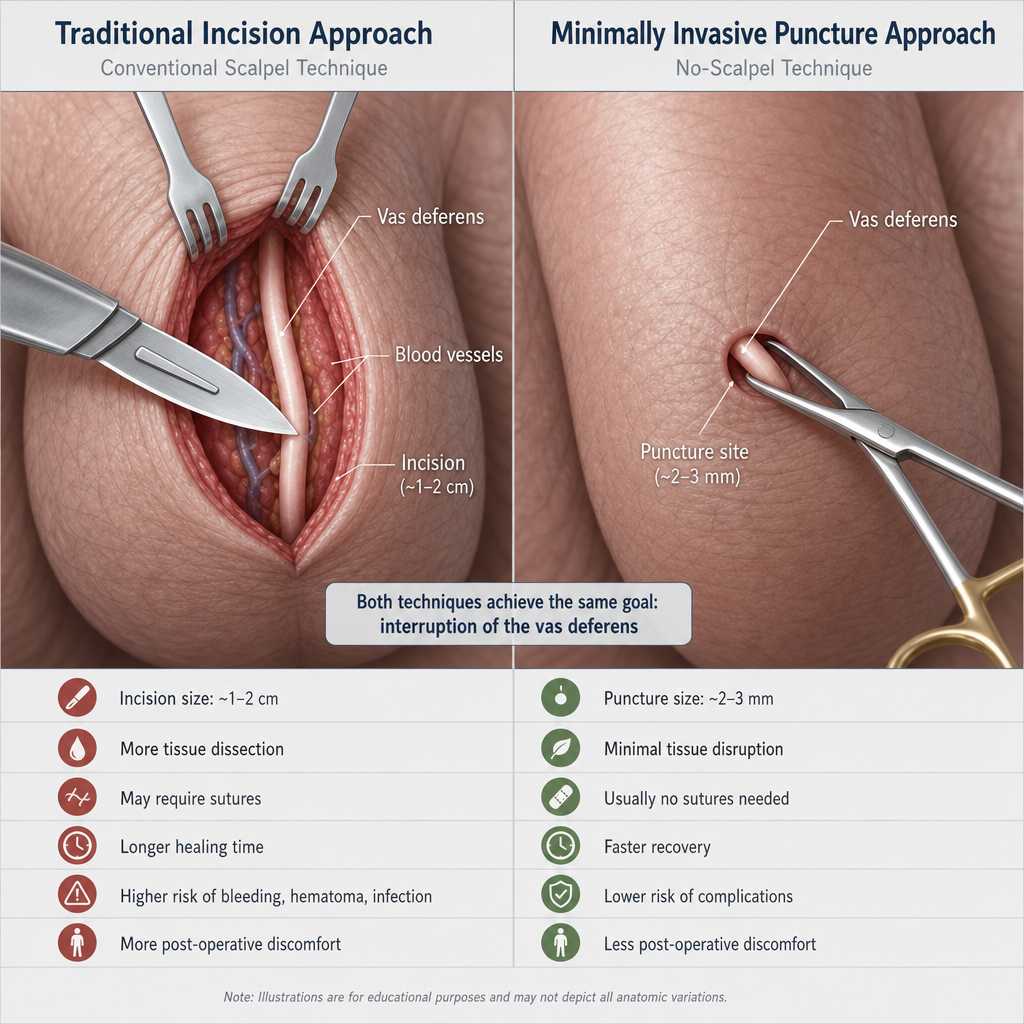
Side-by-side medical illustration comparing traditional scalpel incision versus no-scalpel puncture technique for vasectomy procedures

A no-scalpel vasectomy is a minimally invasive procedure developed in China in the 1970s by Dr. Li Shunqiang and later introduced to the United States in 1988 by Dr. Marc Goldstein at Cornell. Instead of making one or two incisions with a scalpel, the urologist uses a small sharp-tipped instrument called a hemostat to puncture the skin of the scrotum, stretching a tiny opening rather than cutting tissue.

The vas deferens, the tube that carries sperm, is then lifted through that small opening, cut, and sealed. The puncture is so small it typically requires no sutures and closes on its own within a few days. At a clinic like Shan Vasectomy in Huntington Woods, this technique is the standard of care, not an upgrade you have to ask for.

What Is a Traditional Vasectomy?

The traditional vasectomy uses a scalpel to make one or two small incisions in the scrotal skin, usually between 1 and 2 centimeters each. The surgeon reaches through these cuts to locate, cut, and seal each vas deferens. The incisions are then closed with dissolvable sutures.

This approach has been performed safely for decades and is still considered effective. The issue is not whether it works. The issue is that the no-scalpel method accomplishes the same outcome with measurably less tissue trauma, less bleeding, and a faster return to normal activity. Continuing to use the traditional approach when a better option exists is a choice, not a medical necessity.

Quick Takeaways

Key Insight Explanation
No-scalpel means no cutting of the skin A sharp puncture replaces a scalpel incision, reducing bleeding and tissue damage significantly.
Complication rates are lower with the no-scalpel method Studies show hematoma and infection rates are roughly half those seen with traditional incision vasectomy.
Recovery is faster with the no-scalpel approach Most men return to desk work within 48 hours and physical labor within 5 to 7 days.
No-needle anesthesia adds another layer of comfort A pressurized jet delivers local anesthetic without a needle stick, eliminating the sharpest moment of discomfort.
Effectiveness is identical between methods Both approaches achieve a failure rate of less than 1 in 2,000, so technique does not change long-term success.
Flat-rate pricing removes hidden costs At Shan Vasectomy, the $600 flat fee covers consultation, the procedure, and all follow-up visits with no surprise billing.
Michigan men have direct access to no-scalpel specialists Dr. Thulasi Shanmukanathan performs no-scalpel, no-needle vasectomy at the Huntington Woods clinic, serving the greater Detroit metro area.

Key Procedure Differences You Actually Feel

When men ask about the difference between these two approaches, they are really asking one question: how much is this going to hurt? The honest answer is that the no-scalpel method produces less discomfort at every stage of the procedure, and the data on complication rates backs that up.

The Anesthesia Step

In a traditional vasectomy, local anesthetic is delivered via a syringe needle directly into the scrotal tissue. For most men, this is the worst moment of the entire procedure. With no-needle anesthesia, a MadaJet or similar pressurized injector disperses the anesthetic through the skin using air pressure. There is a sensation of pressure, not a needle sting. At Shan Vasectomy, both the no-scalpel technique and no-needle anesthesia are standard, which means patients are not paying extra for a gentler experience.

The Skin Entry Step

The traditional scalpel incision cuts through skin, subcutaneous tissue, and sometimes underlying fascia. Each layer needs to be separated and later sutured. The no-scalpel puncture stretches the same tissue layers without severing them. Stretched tissue heals faster than cut tissue, has fewer nerve endings disrupted, and produces less post-procedural swelling.

The Vas Deferens Occlusion Step

Both methods use the same techniques to block the vas deferens, including cutting, cauterizing, tying, or a combination. This step does not differ meaningfully between approaches. The variation in patient experience comes entirely from how the surgeon accessed the vas, not from what they did to it once found.

Pro tip: Ask any vasectomy provider in Michigan which specific occlusion method they use. The most reliable approach combines excision of a small vas segment with mucosal fulguration (burning the inner lining) and fascial interposition. This combination carries the lowest published failure rate.

Image is being generated...

Recovery Comparison: No-Scalpel vs Traditional

Recovery is where the two methods diverge most noticeably in a patient’s day-to-day experience. Traditional vasectomy typically involves 3 to 5 days of significant soreness, some bruising, and a recommendation to avoid any physical exertion for up to a week. Sutures add a minor maintenance requirement and occasionally cause local irritation before dissolving.

With a no-scalpel vasectomy, the puncture site is roughly the size of a ballpoint pen tip. Most patients at Shan Vasectomy report manageable soreness for 24 to 48 hours, with the majority returning to sedentary work within two days. Physical laborers or men who exercise heavily typically need 5 to 7 days before returning to full activity.

What to Expect in the First 72 Hours

Ice applied intermittently during the first 24 hours reduces swelling effectively. Supportive underwear matters more than most men expect. Scrotal support keeps the area from moving, which directly reduces pain. Over-the-counter ibuprofen handles post-procedural discomfort for most patients without requiring prescription pain medication.

When You Need a Follow-Up Semen Analysis

Neither method provides instant sterilization. Sperm remain in the reproductive tract downstream of the vasectomy site and must be cleared through ejaculation over several weeks. A follow-up semen analysis at approximately 8 to 12 weeks, or after roughly 20 ejaculations, confirms zero sperm count. This step is included in the Shan Vasectomy flat fee, which means there is no reason to skip it.

Pro tip: Do not assume you are sterile before getting a confirmed zero sperm count result. Unintended pregnancies after vasectomy most often occur because men skipped the follow-up analysis and resumed unprotected sex too soon.

Complication Rates and What the Data Shows

The clinical literature on vasectomy complications is consistent and well-established. According to research published through the American Urological Association and summarized by the National Institutes of Health, the no-scalpel technique reduces hematoma formation (blood pooling under the skin) by approximately 50 to 60 percent compared to the traditional incision method. Infection rates follow a similar pattern.

“The no-scalpel vasectomy technique is associated with fewer complications, less bleeding, less pain, and faster recovery than the conventional incision technique, without any compromise in efficacy.” – American Urological Association Foundation, Guidelines on Vasectomy

Hematoma is the most common serious complication from any vasectomy approach, occurring in 1 to 2 percent of traditional procedures versus roughly 0.5 percent with the no-scalpel method. Infection rates for traditional vasectomy run between 1.5 and 3 percent; for no-scalpel procedures, published figures are consistently below 1 percent.

Chronic scrotal pain, sometimes called post-vasectomy pain syndrome, affects an estimated 1 to 2 percent of vasectomy patients regardless of technique. This is not a differentiating factor between methods, but it is worth knowing before you schedule.

Image is being generated...

Side-by-Side Procedure Comparison

The table below compares the no-scalpel vasectomy, the traditional incision vasectomy, and the no-scalpel plus no-needle combination offered at Shan Vasectomy. All three are effective permanent contraception methods, but the differences in patient experience are real and documented.

Feature Traditional Vasectomy No-Scalpel Vasectomy No-Scalpel, No-Needle Vasectomy (Shan Vasectomy)
Skin entry method Scalpel incision (1-2 cm) Sharp puncture, no cutting Sharp puncture, no cutting
Anesthesia delivery Needle injection Needle injection (usually) Pressurized jet, no needle
Sutures required Yes, dissolvable stitches Rarely needed Rarely needed
Hematoma rate 1-2% Approx. 0.5% Approx. 0.5%
Typical return to desk work 3-5 days 1-2 days 1-2 days
Procedure duration 20-30 minutes 15-20 minutes 15-20 minutes
Long-term effectiveness Less than 1 in 2,000 failure Less than 1 in 2,000 failure Less than 1 in 2,000 failure
All-in cost at Michigan specialist Varies widely, often $800-$1,500+ Varies by provider $600 flat (consultation, procedure, follow-up)

Cost and Access in Michigan

Vasectomy pricing in Michigan is inconsistent. Some urology practices bill the consultation separately, charge facility fees on top of the procedure, and send a third bill for the semen analysis follow-up. Men who thought they were paying $600 sometimes end up with invoices totaling well over $1,200 after insurance adjustments and unbundled fees.

Shan Vasectomy’s flat rate of $600 covers the consultation, the no-scalpel no-needle procedure itself, and all required follow-up visits including the semen analysis. There is no facility fee, no anesthesiologist bill, and no surprise invoice. For men paying out of pocket or navigating high-deductible insurance plans, this pricing model removes a significant source of stress.

How Shan Vasectomy Compares to Other Michigan Providers

Other Michigan vasectomy providers, including those serving the Metro Detroit area, offer vasectomy services but vary in technique, pricing transparency, and specialization level. A urologist who performs vasectomies as a small fraction of their overall practice is not the same as a physician whose clinic is dedicated exclusively to this procedure. Specialization matters because volume drives proficiency, and proficiency drives outcomes.

Dr. Thulasi Shanmukanathan at Shan Vasectomy performs exclusively no-scalpel, no-needle procedures. The clinic is built around this single service, which means every aspect of the patient experience, from scheduling to post-procedure care, is designed for vasectomy patients specifically.

Choosing the Right Provider in Michigan

The technique matters, but so does the person performing it. When evaluating vasectomy Michigan providers, there are three questions worth asking before you book an appointment.

How Many Vasectomies Does the Provider Perform Per Year?

Volume is a legitimate quality indicator in procedural medicine. A provider performing 200 or more vasectomies annually has encountered a much wider range of anatomical variation than someone doing 20. Ask directly. A confident, experienced provider will answer without hesitation.

Is No-Scalpel the Default, or an Upgrade?

Some practices still offer traditional vasectomy as their default and position no-scalpel as a premium service. Given that no-scalpel has been the recommended standard since the late 1980s, any clinic still defaulting to the traditional approach deserves scrutiny. At Shan Vasectomy, no-scalpel and no-needle are simply how the procedure is done, not an option you have to negotiate for.

What Does the All-In Cost Actually Include?

Get a written breakdown before you commit. Confirm that the follow-up semen analysis is included. Confirm there is no separate facility fee. Confirm that if you need a second follow-up visit, it is covered. Transparency in pricing is a reasonable expectation, and practices that cannot provide a clear answer before the procedure are unlikely to be clearer when the bills arrive.

Frequently Asked Questions

Is a no-scalpel vasectomy less effective than a traditional vasectomy?

No. Both methods achieve the same long-term effectiveness, with failure rates below 1 in 2,000 when performed correctly with a reliable occlusion method. The difference between the two approaches is entirely in the patient experience, recovery, and complication risk, not in the contraceptive outcome.

How long does a no-scalpel vasectomy take at Shan Vasectomy?

The procedure itself typically takes 15 to 20 minutes. When you include check-in, preparation, and post-procedure instructions, plan for roughly 45 minutes to an hour at the clinic. The $600 flat rate at Shan Vasectomy covers this visit, the consultation, and all follow-ups.

Will I feel pain during a no-scalpel vasectomy?

With no-needle anesthesia and the no-scalpel technique, most men report feeling pressure rather than sharp pain. You may feel a mild ache or tugging sensation when the vas deferens is manipulated, which is normal. The absence of a needle injection and a scalpel incision eliminates the two most commonly reported sources of procedural discomfort in traditional vasectomy.

How soon can I have sex after a no-scalpel vasectomy?

Most providers recommend waiting at least 5 to 7 days before resuming sexual activity. More importantly, you must continue using contraception until a follow-up semen analysis confirms a zero sperm count, which typically happens at 8 to 12 weeks post-procedure. Skipping the semen analysis is the single most preventable cause of vasectomy failure.

Does insurance cover no-scalpel vasectomy in Michigan?

Many insurance plans cover vasectomy, but coverage varies widely. Some plans have high deductibles that make out-of-pocket payment more practical. Shan Vasectomy’s $600 flat fee is often comparable to or less than the out-of-pocket cost under many deductible structures, making it worth calculating both paths before assuming insurance is the better route.

What is the recovery difference between no-scalpel and traditional vasectomy for someone with a physical job?

For men doing manual labor, construction, or heavy lifting, the no-scalpel method offers a meaningful advantage. Traditional vasectomy typically requires 7 to 10 days before returning to strenuous physical work. With the no-scalpel approach, most men with physical jobs return to full activity within 5 to 7 days. Scheduling the procedure on a Thursday gives most men a full work week of recovery before returning to labor-intensive work the following week.

Is vasectomy reversal possible if I change my mind?

Vasectomy reversal is technically possible through microsurgery, but it is expensive (often $5,000 to $15,000), not consistently covered by insurance, and success rates decline with time since the original vasectomy. Vasectomy should be approached as a permanent decision. If you have significant doubts about future family planning, that conversation should happen before scheduling, not after.

If you have been through a no-scalpel vasectomy procedure yourself or are currently weighing your options in Michigan, share your questions or experience in a comment below. Real patient perspectives help other men make better-informed decisions.

References

Categories
Uncategorized

No Needle Vasectomy: Is It Really Pain-Free?

Most men who delay vasectomy do so because of one specific fear: the needle. The idea of an injection directly into the scrotum is enough to make anyone hesitate. That fear is legitimate, and it deserves a straight answer rather than reassuring marketing language. A no needle vasectomy uses a high-pressure jet injector to deliver anesthetic through the skin without a traditional syringe, and the clinical evidence, combined with consistent patient feedback, shows a meaningful difference in the pain experience. But “pain-free” is a phrase that requires context.

Table of Contents

What Is a No Needle Vasectomy and How Does It Work

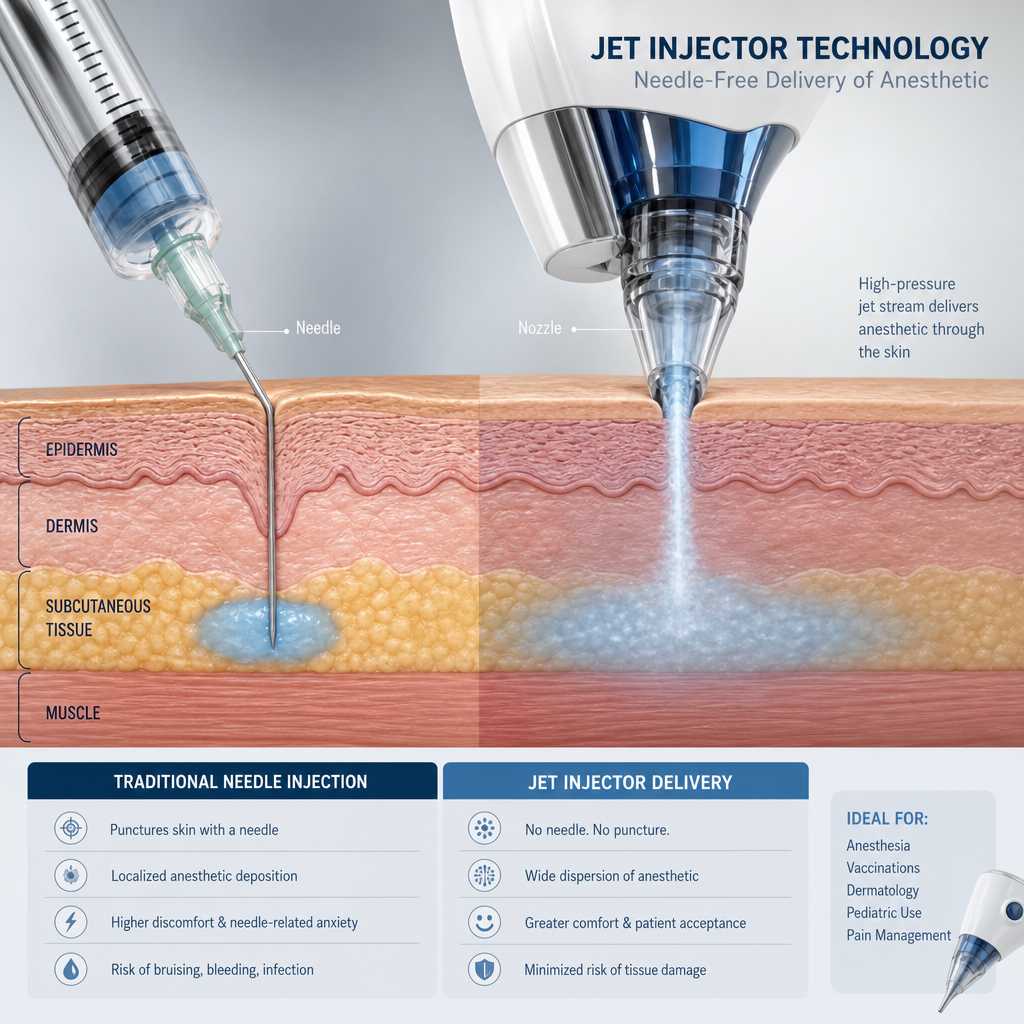
Jet injector device delivering anesthetic without a needle

The term no needle vasectomy refers specifically to the anesthesia delivery method, not the procedure itself. Instead of a syringe and needle puncturing the scrotal skin, a device called a MadaJet injector uses pressurized air to push a fine stream of anesthetic through the skin at high velocity. The anesthetic disperses under the skin and numbs the vas deferens and surrounding tissue in seconds.

At Shan Vasectomy in Huntington Woods, Michigan, Dr. Thulasi Shanmukanathan combines this no-needle anesthesia with a no-scalpel technique. The no-scalpel approach replaces the traditional surgical incision with a small puncture made by a specialized forceps tool. Together, these two refinements reduce trauma, bleeding, and recovery time compared to older vasectomy methods.

The MadaJet device has been used in urology and dentistry for decades. It is not experimental. Patients feel a brief sensation often described as a rubber band snap or a light pinch, and within about 60 to 90 seconds the area is numb enough to proceed with the vasectomy itself.

Quick Takeaways

Key Insight Explanation
“Pain-free” means different things at different stages The anesthesia injection itself causes minimal sensation, but mild discomfort during and after the procedure is still common for many men.
The no-needle injector eliminates the worst moment for most patients Clinical surveys show that anticipatory fear of the needle is consistently rated as the most dreaded part of a traditional vasectomy.
Pressure sensations are normal and do not indicate pain Most patients feel pulling or tugging during the procedure. This is not pain. It is the normal sensation of tissue manipulation under local anesthesia.
Post-procedure soreness typically lasts 2 to 3 days Over-the-counter pain relievers and an ice pack are usually sufficient. Most men return to desk work within 24 to 48 hours.
Anxiety amplifies perceived pain Men who arrive informed and calm consistently report better experiences than men who arrive with high anxiety and minimal preparation.
The flat $600 fee at Shan Vasectomy includes everything Consultation, the procedure, and all follow-up visits are included. No hidden fees reduces one common source of patient stress.
Most men say the fear was worse than the procedure This is the single most repeated comment in patient feedback across urology practices that offer no-needle techniques.

The Pain Scale Reality: What Patients Actually Report

Patient feedback across urology practices offering no needle vasectomy consistently clusters around a 1 to 3 on a 10-point pain scale during the procedure itself. That figure comes from multiple published patient satisfaction surveys, including studies referenced in peer-reviewed urology literature. The anesthetic injection discomfort with the jet injector is typically reported as a 1 or 2, while any discomfort felt during the vas deferens manipulation is usually a 2 to 3.

Image is being generated...

To put that in context, most patients rate a standard blood draw at a 2 to 3. The no needle anesthesia injection compares favorably to a routine blood draw in the arm, and the body part involved is far less frightening once the actual sensation is experienced rather than imagined.

In practice, the most common complaint is not pain but an odd pulling or tugging sensation when the vas deferens is manipulated. This is expected, it is brief, and it does not register as sharp pain for the majority of men. Some men with higher baseline anxiety or lower pain tolerance do report a 4 or 5, and that deserves acknowledgment. But reports above a 5 are rare when a skilled provider using proper technique delivers adequate anesthesia.

What the word “painless” actually means in vasectomy marketing

Many clinics use the word painless freely. A more accurate description is minimally uncomfortable. The no needle technique removes the most acutely feared sensation, which is the scrotal needle, but it does not eliminate all sensation. Men who walk in expecting zero sensation sometimes rate their experience lower than men who were given accurate expectations and experienced the same procedure. Expectation management is part of clinical skill, and it is part of what a good pre-procedure consultation handles.

Pro tip: Ask your provider specifically what sensations to expect at each stage of the procedure, not just whether it will hurt. Understanding the difference between pressure and pain before you are on the table makes a real difference in your experience.

No Needle vs. Traditional Needle Vasectomy: A Real Comparison

The distinction between no-needle and traditional approaches is not marketing fluff. There are measurable clinical differences in patient experience, complication rates, and recovery time. The table below outlines the key differences based on published urology outcomes data and patient-reported experience patterns.

Factor No Needle No Scalpel Vasectomy Traditional Needle and Scalpel Vasectomy
Anesthesia delivery Jet injector, no puncture, rated 1-2 on pain scale Syringe needle into scrotal skin, rated 4-6 on pain scale by many patients
Access incision Small puncture with specialized forceps, no stitches needed One or two surgical incisions, often requires sutures
Bleeding and hematoma risk Lower, estimated at under 1% in high-volume practices Higher, estimated at 2 to 3% in published studies
Recovery time Most men return to light activity in 24 to 48 hours Typically 3 to 5 days before returning to light activity
Post-procedure soreness Mild, managed with OTC pain relievers and ice Moderate, often requires several days of rest and pain management

The data consistently shows that the no-needle, no-scalpel approach produces fewer complications and a better patient experience without any reduction in vasectomy effectiveness. The procedure is equally permanent. The difference is entirely in how the patient experiences the process.

“The no-scalpel vasectomy has become the preferred technique among urologists precisely because it delivers equivalent outcomes with substantially less patient discomfort and a lower complication profile than conventional methods.” – Journal of Urology, referenced in American Urological Association clinical practice guidance

The Anxiety Factor and Why It Matters as Much as the Needle

Fear of vasectomy pain is not irrational. The scrotal area is densely innervated and emotionally significant. Men who have never had a urological procedure often arrive with catastrophic mental images based on secondhand horror stories or outdated descriptions of older procedures. That anxiety is not a character flaw. It is a predictable psychological response that directly affects pain perception.

Image is being generated...

Anxiety lowers the pain threshold. This is not theoretical. Studies in pain psychology consistently demonstrate that anticipatory fear intensifies the subjective experience of discomfort. A man who arrives convinced the procedure will be unbearable often reports higher pain scores than a man who arrives calm and informed, even when both receive identical procedures from the same provider.

How a good consultation reduces pain perception

At Shan Vasectomy, the initial consultation is included in the flat $600 fee precisely because preparation matters. A provider who walks a patient through each step, explains what sensations are normal, and answers specific questions about the no-needle technique reduces anxiety and therefore reduces perceived pain. This is not a soft benefit. It is a clinically meaningful part of the patient experience.

A common mistake is treating the consultation as an administrative formality. Men who skip or rush the consultation and proceed without understanding the procedure almost always report worse experiences than those who spent time asking questions and getting direct answers.

Pro tip: Write down your three biggest fears about the procedure before your consultation. Bring that list. A good vasectomy provider will address each one directly, and you will feel measurably more prepared walking into the procedure room.

Post-Procedure Discomfort: What to Expect in the Days After

The procedure itself is the part most men dread, but post-procedure soreness is the part that actually affects daily life. The painless vasectomy claim, when it exists, refers primarily to the procedure. Recovery involves real but manageable discomfort for the majority of patients.

Most men who have a no-needle, no-scalpel vasectomy describe the recovery as feeling like they were lightly kicked in the groin, with soreness that peaks in the first 24 hours and largely resolves within 48 to 72 hours. Ibuprofen and an ice pack on a schedule, not just when it hurts, handle the discomfort effectively for most patients. A supportive athletic garment reduces movement and provides meaningful relief.

Physical activity restrictions during recovery

Men with desk jobs can typically return to work the following day. Men with physically demanding jobs, including lifting, construction, or extended standing, should plan for 3 to 5 days before returning. Strenuous exercise, including anything that elevates heart rate significantly, should wait 5 to 7 days. Sexual activity is generally cleared at the one-week mark, but contraception must continue until a follow-up semen analysis confirms zero sperm count. That confirmation is part of why follow-up visits are included in the Shan Vasectomy fee.

When soreness is not normal

Sharp, increasing pain after the first 48 hours is not expected. Significant swelling that grows rather than diminishes, fever, or discharge from the puncture site are signs to contact the provider immediately. These complications are uncommon with a no-scalpel technique but are not impossible. Patients at Shan Vasectomy have direct access to follow-up care, and that accessibility matters when something feels off during recovery.

Who Qualifies for a No Needle No Scalpel Vasectomy

The vast majority of men seeking permanent contraception are good candidates for a no-needle, no-scalpel vasectomy. There is no age restriction beyond being an adult. There is no requirement to have children already, though some providers may discuss future plans during the consultation as part of informed consent. Being in generally good health and having no active scrotal infections or unusual anatomy are the primary practical qualifications.

Men with certain anatomical variations, such as a prior scrotal surgery, a varicocele, or significant scar tissue from previous procedures, may require a modified approach or a more detailed pre-procedure evaluation. This is why an in-person consultation is part of the standard process. A provider cannot determine candidacy accurately from a form or a phone call alone.

Men who have blood clotting disorders or who are taking blood thinners will need to discuss their medication management before the procedure. This applies to any minor surgical procedure. In most cases, a brief pause in anticoagulant medication is all that is needed, under guidance from the prescribing physician.

Frequently Asked Questions

Does a no needle vasectomy hurt at all?

Most patients describe the anesthesia delivery as a brief snapping sensation, rated 1 to 2 out of 10. Once the anesthetic takes effect, the procedure itself involves pressure and pulling sensations but not sharp pain for the majority of men. Post-procedure soreness over the following 1 to 3 days is real but manageable with over-the-counter medication and rest.

How is the no needle technique different from a regular vasectomy injection?

A traditional vasectomy uses a syringe with a needle that punctures the scrotal skin to deliver local anesthetic. This injection is consistently rated as the most painful part of the procedure. The no-needle technique uses a pressurized jet injector that pushes anesthetic through the skin without a puncture, eliminating that acute pain while achieving the same numbness.

How long does the discomfort last after a no scalpel vasectomy?

For most men, soreness peaks in the first 24 hours and becomes minor by 48 to 72 hours. Men who follow the recommended recovery protocol, meaning rest, ice, supportive underwear, and scheduled ibuprofen, tend to recover faster than men who try to resume normal activity too quickly.

Will I be awake during the procedure?

Yes. A no-needle, no-scalpel vasectomy is performed under local anesthesia, meaning you are awake but the procedure area is numb. General anesthesia is not used and not necessary. Most procedures are completed in 15 to 20 minutes. Being awake and able to communicate with the provider is actually an advantage, as you can report any unexpected sensation immediately.

Is the vasectomy still effective if done without a needle or scalpel?

Yes. The no-needle and no-scalpel designations describe the delivery of anesthesia and the access technique, not the vasectomy itself. The vas deferens is still interrupted by the same methods, and the effectiveness rate of the procedure is not reduced. Vasectomy remains over 99% effective as a permanent contraception method regardless of which access technique is used.

How soon after the procedure will I know if it worked?

A follow-up semen analysis, typically performed about 8 to 12 weeks after the procedure, confirms whether the vasectomy was successful. Contraception must be used until that analysis shows a zero sperm count. At Shan Vasectomy, follow-up visits including this analysis are included in the flat $600 fee, so there are no additional costs for confirmation.

Have you had a no needle vasectomy, or are you still weighing the decision? Share what questions are on your mind and what would help you feel more confident about the process.

References

Categories
Uncategorized

Vasectomy Recovery Timeline: What to Expect After

Most men are surprised to learn that vasectomy recovery is measured in days, not weeks. The no-needle, no-scalpel approach used at Shan Vasectomy in Huntington Woods, Michigan, takes that recovery window even shorter than traditional methods. Yet a significant number of men still delay scheduling the procedure because they overestimate downtime, or they follow the wrong advice after the procedure and extend their discomfort unnecessarily. This guide gives you the complete, honest recovery timeline, day by day, so you know exactly what to expect after your no-needle vasectomy and can plan accordingly.

Table of Contents

Quick Takeaways

Key Insight Explanation
Most men return to desk work in 2 days Sedentary jobs require very little recovery time after a no-needle vasectomy. Physical labor jobs typically need 5 to 7 days off.
Ice is your best tool in the first 48 hours Applying ice packs for 20 minutes on, 20 minutes off reduces swelling and discomfort more effectively than relying solely on pain medication.
You are not sterile immediately after the procedure Residual sperm remain in the reproductive tract. Contraception must be used until a semen analysis at 8 to 12 weeks confirms zero sperm count.
Scrotal support matters more than most men expect Wearing snug, supportive underwear or an athletic supporter for the first week significantly reduces pulling discomfort and speeds healing.
Sexual activity can resume around day 7 Most men can safely resume sexual activity after one week, though individual healing varies. Discomfort during ejaculation in the first few days is normal.
The no-needle technique reduces bruising By avoiding a traditional injection needle, the no-needle approach causes less local tissue trauma, which typically means less bruising and a faster recovery start.
Follow-up is included in the $600 flat rate at Shan Vasectomy All necessary follow-up visits, including the semen analysis review, are part of the flat-rate fee, so there are no surprise costs during recovery.

Why No-Needle Vasectomy Recovery Is Different

Man working at a desk after vasectomy recovery, appearing comfortable during the first days of healing

The term “no-needle, no-scalpel” is not just marketing language. It describes two genuine procedural differences that directly affect vasectomy recovery. Traditional vasectomies use a needle to inject local anesthetic into the scrotal skin, and that injection itself causes tissue trauma and bruising before the procedure even begins. The no-needle method uses a jet injector to deliver the anesthetic through the skin without puncturing it, which means less tissue disruption from the very first step.

The no-scalpel component replaces the traditional incision with a small puncture made using a specialized instrument. That puncture does not require sutures in most cases, which eliminates one source of post-procedure soreness and one potential site for complications. At Shan Vasectomy, Dr. Thulasi Shanmukanathan performs this procedure using both techniques together, and the clinical result is a shorter, less traumatic experience that sets men up for a faster recovery from the moment they leave the clinic.

In practice, the difference is noticeable. Men who have had a traditional vasectomy at another clinic and later discuss the experience often report that the injection was the most uncomfortable part. That discomfort is removed entirely with the no-needle approach, and the downstream effect on vasectomy healing time is real.

Image is being generated...

The First 24 Hours: What Normal Looks Like

The first 24 hours after your vasectomy set the tone for the rest of your recovery. Most men leave the clinic within 30 minutes of the procedure finishing and feel well enough to walk to their car. The local anesthetic typically lasts two to four hours, so expect some achiness to begin in the afternoon if you had a morning appointment.

What you will feel in the first few hours

A dull ache in the scrotal area is normal and expected. Some men describe it as similar to being hit in the groin, though less intense. Over-the-counter ibuprofen or acetaminophen manages this effectively for the vast majority of patients. Prescription pain medication is rarely needed after a no-needle procedure.

Mild swelling is also normal. The scrotum may look slightly puffy by the end of day one. This is not a sign that anything went wrong. It is your body’s inflammatory response to the procedure.

What you should be doing in the first 24 hours

Rest is the single most important thing you can do on day one. Lying down, keeping your feet elevated where possible, and applying ice to the area in 20-minute intervals will do more for your recovery than anything else. Do not attempt to push through discomfort by staying active. Physical activity on day one consistently leads to increased swelling and longer overall recovery time.

Wear snug, supportive underwear from the moment you leave the clinic. Briefs or a jockstrap keep the scrotum supported and reduce the pulling sensation that comes with movement. Loose boxers are the wrong choice for the first week of vasectomy recovery.

Pro tip: Buy two bags of frozen peas before your procedure date. They conform to the area better than standard ice packs and can be refrozen between uses. Keep them rotating throughout day one.

Days 2 Through 7: The Active Healing Phase

By day two, most men feel meaningfully better than they did on day one. The sharpest discomfort has typically passed, and swelling begins to reduce. This phase of recovery is where patients most commonly make mistakes by doing too much too soon.

Returning to work

Men with desk-based or sedentary jobs can usually return to work on day two or three. If your job requires sitting at a computer, answering calls, or performing light tasks, you are almost certainly fine to return within 48 hours. Remote work from a couch or recliner on day two is a reasonable option for those who feel up to it.

Physical labor is a different story. Construction, landscaping, warehouse work, and anything that requires heavy lifting, prolonged standing, or straining should be avoided for a full five to seven days. Going back too early risks increased swelling and, in rare cases, hematoma formation.

Physical activity and exercise restrictions

Light walking is fine from day two onward. Anything more strenuous, including jogging, cycling, weightlifting, or sports, should wait until at least day seven and ideally until there is no soreness remaining. The data consistently shows that men who resume intense exercise too early have higher rates of post-procedure swelling and discomfort that can linger for weeks.

Cycling deserves a specific mention. Bike seats place direct pressure on the perineal area and should be avoided for at least two full weeks after the procedure. This applies to both road bikes and stationary gym bikes.

Sexual activity after vasectomy

The general guideline is to wait one week before resuming sexual activity. Ejaculation in the first few days after the procedure can cause a pulling or aching sensation as the vas deferens moves through the healing tissue. It will not cause damage, but it is uncomfortable enough that most men naturally wait. Use contraception every time until your semen analysis confirms a zero sperm count.

Pro tip: Mark the date of your procedure in your calendar and set a reminder for eight weeks out. That is approximately when you will need to submit a semen sample to confirm the vasectomy worked. Do not skip this step, regardless of how well your recovery goes.

Weeks 2 Through 4: Returning to Full Activity

By the start of week two, the vast majority of men feel completely normal in day-to-day life. Any remaining discomfort is usually mild and intermittent rather than constant. Swelling should be gone or nearly gone. This is the phase where most patients forget they had a procedure at all.

Full physical activity, including gym workouts and sports, is generally safe by the two-week mark as long as there is no ongoing soreness. If you are still feeling discomfort at two weeks, that is worth mentioning to Dr. Shanmukanathan at your follow-up appointment rather than pushing through it.

What the post-vasectomy ache actually is

A small percentage of men experience a residual aching sensation in the testicles during the first few weeks that comes and goes without obvious cause. This is sometimes called post-vasectomy pain and it is different from the normal recovery soreness. In most cases it resolves on its own within a month. Persistent discomfort beyond four to six weeks is uncommon after a no-needle procedure but should always be evaluated.

“The no-scalpel vasectomy has been shown in multiple clinical studies to have lower complication rates, including lower rates of hematoma, infection, and prolonged pain, compared to conventional incisional techniques.” – Urology Care Foundation, American Urological Association

This matters because choosing a clinic that performs the no-needle, no-scalpel approach is not just about procedure day comfort. It directly reduces your risk of complications that could extend your overall vasectomy healing time.

Image is being generated...

Vasectomy Healing Time: Comparing Recovery Approaches

Understanding how different procedural approaches affect recovery helps you make a better-informed decision when choosing a provider. Not all vasectomies are the same, and the technique your doctor uses has a direct impact on your experience in the days and weeks after the procedure.

Approach Typical Return to Desk Work Typical Return to Physical Labor
No-Needle, No-Scalpel (Shan Vasectomy) 1 to 2 days 5 to 7 days
No-Scalpel with Traditional Needle Anesthesia 2 to 3 days 7 days
Conventional Incisional Vasectomy 3 to 5 days 7 to 10 days

The difference between the no-needle approach and a conventional incisional vasectomy may seem minor in terms of days, but for men who have time-sensitive work commitments or physically demanding jobs, those extra days matter. The clinical advantage of avoiding both the injection needle and the scalpel compounds during recovery, with less bruising, less tissue trauma, and a lower risk of hematoma all contributing to a faster and more comfortable healing process.

What Can Go Wrong and How to Recognize It

The vast majority of vasectomy recoveries are uneventful, but knowing what legitimate warning signs look like is important. A common mistake is dismissing symptoms that warrant a call to the clinic, or conversely, panicking over normal post-procedure bruising.

Hematoma

A hematoma is a collection of blood that forms in the scrotum after the procedure. It presents as significant swelling, tightness, and sometimes a bluish discoloration. Minor bruising is normal. A hematoma, by contrast, causes the scrotum to feel hard and substantially enlarged. It is the most common serious complication after a vasectomy. The no-scalpel technique significantly reduces this risk, but it can still occur, particularly if men resume physical activity too soon.

Infection

Signs of infection include increasing redness, warmth, and swelling at the puncture site after the first 48 hours, accompanied by fever. Normal recovery soreness decreases over time. Infection symptoms worsen. If you notice these signs, contact the clinic promptly. Infections are rare with the no-scalpel approach because there is no open wound, but they are not impossible.

Sperm granuloma

A sperm granuloma is a small, firm lump that can develop near the site where the vas deferens was sealed. It forms as a reaction to sperm leaking from the sealed end. Most granulomas are painless and resolve on their own. If one causes persistent tenderness, a follow-up visit with Dr. Shanmukanathan will determine whether any treatment is needed.

Confirming Success: The Semen Analysis You Cannot Skip

A vasectomy is not considered successful until a semen analysis confirms the absence of sperm. This is a non-negotiable step in the recovery process, and it is one that too many men skip because they feel fine and assume everything worked.

At Shan Vasectomy, the standard recommendation is to submit a semen sample at 8 to 12 weeks after the procedure. At that point, most men will have had enough ejaculations to clear residual sperm from the reproductive tract. The sample is analyzed under a microscope. A zero sperm count means the vasectomy is confirmed effective. Any residual motile sperm means additional testing is needed.

Until that analysis comes back negative, contraception is not optional. This is the part of after vasectomy care that carries the most real-world consequences if ignored. Unintended pregnancies do occur when men stop using contraception before confirming a zero count, and that outcome is entirely avoidable.

At Shan Vasectomy, follow-up visits are included in the $600 flat rate. There is no separate billing for the semen analysis review appointment. That removes the financial barrier that sometimes causes men to avoid this final step.

Frequently Asked Questions

How long does vasectomy recovery actually take?

For most men who choose a no-needle, no-scalpel vasectomy, the active discomfort phase lasts two to four days. Returning to a desk job within 48 hours is realistic for the majority of patients. Full physical activity is typically safe by the end of week two. The final confirmation step, a semen analysis, happens at 8 to 12 weeks post-procedure.

Can I drive myself home after the procedure?

No. Even though no general anesthesia is used, you will have received local anesthesia and may feel groggy or uncomfortable. You should arrange for someone to drive you home from the clinic. This is a firm recommendation, not a suggestion.

When is it safe to have sex after a vasectomy?

Most men can safely resume sexual activity after seven days. However, resuming sex does not mean you are protected against pregnancy. You must use contraception until a semen analysis at 8 to 12 weeks confirms a zero sperm count. The two timelines are separate and should not be confused.

Is it normal to feel a lump after a vasectomy?

A small, firm lump near the vasectomy site during the first few weeks is usually a sperm granuloma, which is a normal inflammatory response. It is typically painless and resolves without treatment. If any lump is growing, increasingly tender, or accompanied by fever, contact the clinic for evaluation.

What happens if I go back to the gym too soon?

Returning to strenuous exercise before the tissue has healed increases blood flow to the area and raises the risk of hematoma formation. A hematoma can cause significant swelling and discomfort and may require medical drainage. It can also extend your overall recovery by several weeks. Waiting the full recommended time before resuming exercise is a straightforward way to avoid this outcome.

Does the no-needle technique really reduce recovery discomfort compared to a traditional vasectomy?

Yes, and the difference is clinically meaningful. The injection needle used in traditional vasectomies traumatizes scrotal tissue before the procedure begins. Removing that step means the body has less initial trauma to recover from. Combined with the no-scalpel puncture technique, the result is less bruising, less swelling, and for most men, a noticeably easier first two days compared to what men who had conventional vasectomies have reported.

Why is the semen analysis so important, and what if I feel fine?

Feeling well after the procedure says nothing about whether the vasectomy was anatomically successful. A small percentage of vasectomies initially fail because sperm can still pass through the sealed ends. The only way to confirm the procedure worked is through laboratory analysis of a semen sample. Men who skip this step and stop using contraception are taking a real risk, regardless of how smooth their recovery was.

Have you scheduled your vasectomy consultation, or do you have a specific recovery concern that was not covered here? Leave a comment or reach out to the team at Shan Vasectomy directly with your question.

References

Categories
Uncategorized

5 Vasectomy Myths Stopping Michigan Men From Acting

Roughly half of all unintended pregnancies in the United States involve men who are done having children but have never seriously considered a vasectomy. In Michigan, vasectomy myths are the single biggest barrier between men who want permanent contraception and the procedure that would give them exactly that. These myths are not harmless misunderstandings. They delay decisions, strain relationships, and leave the full burden of birth control on women. This article names the five myths that do the most damage, corrects them with actual vasectomy facts, and explains why a no-scalpel, no-needle procedure at a clinic like Shan Vasectomy in Huntington Woods is far less daunting than the myths suggest.

Table of Contents

Quick Takeaways

Key Insight Explanation
Vasectomy does not affect testosterone The vas deferens carries sperm, not hormones. Testosterone production and libido remain completely unchanged after the procedure.
No-needle vasectomy eliminates the most feared part Modern no-needle anesthesia replaces the traditional injection with a pressurized spray, dramatically reducing discomfort before the procedure even begins.
Over 99% effectiveness rate Vasectomy is one of the most effective forms of contraception available, outperforming condoms and most hormonal methods for men seeking permanent contraception.
No confirmed link between vasectomy and prostate cancer Major health bodies including the American Urological Association have reviewed the evidence and do not classify vasectomy as a risk factor for prostate cancer.
A flat $600 covers everything at Shan Vasectomy That single price includes the consultation, the procedure, and all follow-up visits, making cost comparison with competitors straightforward and honest.
Recovery is typically 2 to 3 days Most men return to desk work within 48 hours. Heavy lifting and vigorous activity should wait about a week, but the recovery is far shorter than myth suggests.
Vasectomy reversal is possible but should not be the plan Reversal success rates decline significantly over time and are not guaranteed. Men should choose vasectomy when they are confident their family is complete.

Myth 1: A Vasectomy Will Affect My Sex Drive or Masculinity

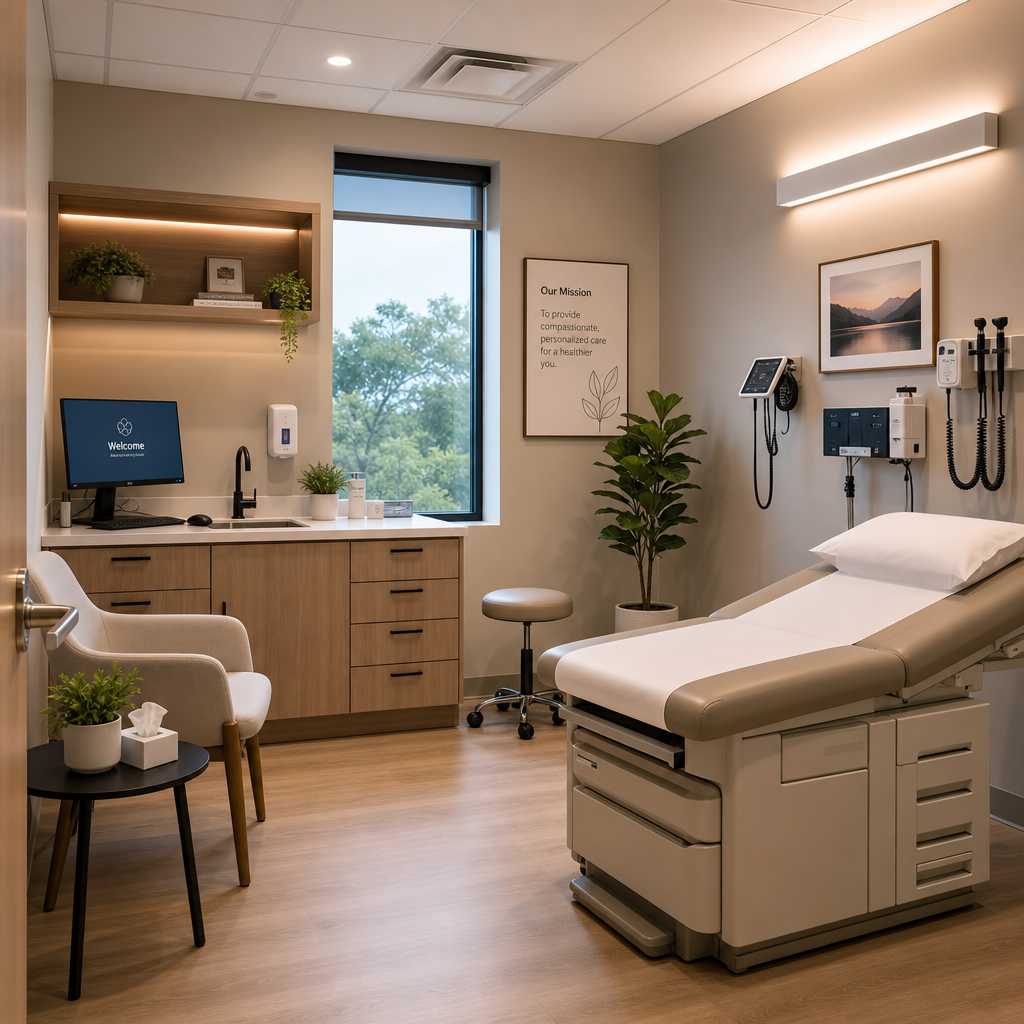
A modern, clean medical clinic examination room with contemporary equipment and warm lighting

This is the myth that shows up most often in the consultation room, and it is the one with the least biological basis. Men conflate reproductive capability with sexual function, which are governed by entirely different systems in the body.

A vasectomy cuts or blocks the vas deferens, the tube that carries sperm from the testicles to the urethra. It does not touch the testicles themselves, which are the primary site of testosterone production. Hormone levels, libido, erectile function, and ejaculation all remain unchanged. The only difference after a successful vasectomy is that semen contains no sperm. Volume, sensation, and frequency of sex are unaffected.

“Vasectomy has no effect on a man’s ability to produce male hormones, have erections, or experience orgasms. Sexual pleasure is not diminished.” – American Urological Association, Clinical Guidelines on Male Contraception

Why the Myth Persists

Cultural associations between fertility and manhood run deep. In practice, what actually happens after vasectomy is the opposite of what men fear. Many couples report improved sexual spontaneity because the constant anxiety around unintended pregnancy is removed. The data consistently shows patient satisfaction rates above 95% for no-scalpel vasectomy procedures.

Men who come into Shan Vasectomy’s Huntington Woods clinic having done their research almost always say the same thing after recovery: they wish they had done it sooner. That sentiment does not describe a procedure that diminishes anything.

Pro tip: If concerns about masculinity or sexual performance are making you hesitate, bring them up directly during your consultation with Dr. Shanmukanathan. These questions have clear, evidence-based answers, and you deserve to hear them before making a decision.

Image is being generated...

Myth 2: The Procedure Is Extremely Painful

Pain is the most emotionally loaded vasectomy myth because it combines real (but manageable) discomfort with second-hand horror stories that get exaggerated with every retelling. Men who have never experienced a vasectomy have a distorted picture built from locker-room anecdotes, not clinical reality.

The no-needle, no-scalpel vasectomy technique used at Shan Vasectomy addresses pain at every stage of the procedure. Traditional vasectomies used a needle injection to deliver local anesthetic, which is itself a source of sharp, anxiety-inducing discomfort. The no-needle technique uses a pressurized MadaJet sprayer to deliver anesthetic through the skin without puncture. Patients consistently describe this sensation as a light snap, comparable to a rubber band on the wrist.

What Men Actually Feel During the Procedure

Once the anesthetic takes effect, most men feel pressure and mild tugging sensations, not pain. The no-scalpel technique makes a tiny puncture rather than an incision, which means less tissue disruption, less bleeding, and a faster recovery. The entire procedure typically takes under 30 minutes.

Post-procedure soreness is real. Most men describe it as similar to mild bruising or the feeling after a minor sports injury. Over-the-counter pain relievers, supportive underwear, and an ice pack manage it effectively for the first 24 to 48 hours. The idea that men are bedridden for a week belongs to an older era of the procedure.

A common mistake is letting fear of anticipated pain outweigh the long-term relief of permanent contraception. The procedure takes less time than most men spend researching it online.

Pro tip: Schedule your vasectomy on a Thursday or Friday. That gives you the weekend to rest comfortably, and most men are back to desk work by Monday without any issue.

Myth 3: It Is Too Permanent and I Might Change My Mind

Permanence is not a defect. It is the entire point. Men seeking permanent contraception do not want to think about birth control again. The concern here is legitimate but is often framed incorrectly as a reason to delay indefinitely rather than as a call to think carefully before proceeding.

Vasectomy should be chosen by men who are confident their family is complete. That is not a casual standard. It means having honest conversations with your partner, thinking through realistic life scenarios, and arriving at a clear decision rather than a default one. When men do that work thoughtfully, regret rates are very low. Research published in the Journal of Urology found that vasectomy regret rates are around 6% when men choose the procedure after careful deliberation, and rates are highest among men who had the procedure before age 30 or without a stable partner.

What Vasectomy Reversal Actually Involves

Reversal is possible, but it is not a reliable backup plan. Vasovasostomy, the surgical reconnection of the vas deferens, costs between $5,000 and $15,000 and is rarely covered by insurance. Success rates drop significantly the longer the interval since the original vasectomy. At 10 or more years post-vasectomy, patency rates (sperm returning to the semen) drop to around 30%. Men should treat vasectomy as permanent and make the decision from that premise.

The framing of permanence as a reason not to act is often a stall tactic driven by other fears, including the ones addressed in the other myths on this list. When those fears are resolved, the permanence of vasectomy becomes its most attractive quality.

Image is being generated...

Myth 4: Vasectomy Increases My Cancer Risk

This myth has a traceable origin. A 1993 study suggested a possible association between vasectomy and prostate cancer, generating widespread anxiety that has never fully faded despite decades of follow-up research reaching the opposite conclusion.

The American Urological Association and the National Cancer Institute have both reviewed the cumulative evidence and concluded that vasectomy does not cause prostate cancer. A 2016 analysis published in the Journal of Clinical Oncology, which examined data from over 180,000 men, found no statistically significant increased risk of prostate cancer from vasectomy. The original 1993 association is now attributed to detection bias: men who had vasectomies saw urologists more often and were therefore more likely to have prostate cancer detected early, not more likely to develop it.

What the Science Actually Supports

There is no credible evidence linking vasectomy to testicular cancer, cardiovascular disease, immune dysfunction, or any of the other health harms that circulate on forums and in social media comments. The procedure is localized to a small segment of reproductive anatomy. Its systemic health effects are effectively zero.

Men who have delayed vasectomy because of cancer concerns have been carrying a fear built on a single outdated study. The vasectomy facts are clear: this is one of the safest elective procedures available to men, with a complication rate under 1% in the hands of an experienced provider like Dr. Thulasi Shanmukanathan.

Myth 5: Vasectomy Is Too Expensive for Most Men

Cost is a legitimate concern for any elective procedure, but the perception that vasectomy is prohibitively expensive does not survive a straightforward comparison with the alternatives. Over a lifetime, vasectomy is one of the most cost-effective contraceptive choices available.

Shan Vasectomy charges a flat rate of $600 for the full package: consultation, procedure, and all follow-up visits. There are no hidden fees. Compare that to the lifetime cost of condoms, which averages roughly $150 to $200 per year, adding up to $3,000 to $4,000 over two decades. Compare it to the cost of a copper IUD or hormonal birth control for a partner, which can range from $500 to over $1,000 per year depending on insurance coverage.

How Shan Vasectomy Compares to Michigan Competitors

Provider Pricing Model What Is Included
Shan Vasectomy (Huntington Woods) Flat $600 all-inclusive Consultation, procedure, and all follow-up visits
Michigan Premier Care / mpcenter.net Variable, insurance-dependent Procedure costs may vary; consult separately billed
Cutting Edge Vasectomy / cuttingedgevasectomy.com Quoted per appointment Follow-up and consultation billing varies by plan

The $600 flat rate removes the anxiety of surprise billing. Men who have priced vasectomies at other Michigan clinics frequently find that separate consultation fees, facility fees, and follow-up charges push the total well above what a transparent flat-rate clinic charges. Knowing the full cost upfront is not just convenient. It is a meaningful difference in how the clinic treats patients.

Men with insurance that covers vasectomy may pay even less out of pocket. It is worth calling your insurer before your consultation to check your specific plan. But even without insurance, $600 for permanent contraception is a fraction of what most families spend managing birth control over five to ten years.

Comparing Permanent Contraception Options for Men

When Michigan men evaluate their options for permanent contraception, the comparison is often framed as vasectomy versus doing nothing. The more useful comparison is vasectomy versus the ongoing alternatives, both in terms of effectiveness and real-world burden.

Method Effectiveness Rate Long-Term Cost and Burden
No-scalpel vasectomy Over 99.9% One-time cost, no ongoing action required after confirmed sterility
Condoms (male) 85% with typical use $150 to $200 per year, requires consistent correct use every time
Female tubal ligation 99.5% Higher surgical complexity, general anesthesia, longer recovery, cost often exceeds $6,000

Tubal ligation is a common default because the burden of birth control has historically fallen on women. Vasectomy is a simpler, lower-risk outpatient procedure with a faster recovery and a lower complication rate than tubal ligation, yet men still account for only about 8% of contraceptive sterilization procedures in the United States, compared to over 27% for women. That gap is almost entirely explained by myths, not by medical reality.

Men who want to share the responsibility of family planning more equitably have a clear path. A no-scalpel vasectomy with Dr. Shanmukanathan is a 30-minute outpatient procedure. A tubal ligation is a surgery requiring general anesthesia and a recovery of one to two weeks. The burden comparison is not close.

Frequently Asked Questions

How long does a no-scalpel vasectomy take at Shan Vasectomy?

The procedure itself typically takes between 20 and 30 minutes. The consultation beforehand can be done in the same visit or scheduled separately. Most men are done and on their way home within an hour of arriving at the Huntington Woods clinic.

Will I need someone to drive me home after the vasectomy?

Yes. While the procedure uses only local anesthesia and you will be fully conscious, the scrotal area will be numb and mildly sore. Having a driver avoids any discomfort from sitting or moving awkwardly, and it gives you a chance to rest immediately after instead of focusing on traffic. Most clinics, including Shan Vasectomy, recommend arranging a ride in advance.

How soon after a vasectomy can I have sex?

Most men can resume sexual activity within one week of the procedure. However, vasectomy is not immediately effective. Sperm remain in the reproductive tract and must be cleared through ejaculation. A semen analysis is performed after the procedure (included in the $600 flat rate at Shan Vasectomy) to confirm that the semen is sperm-free. Until that confirmation, additional contraception should be used.

What is the failure rate of vasectomy?

The failure rate of vasectomy is less than 0.1%, making it one of the most effective contraceptive methods available. Failures are typically due to early unprotected intercourse before confirmed sterility or, rarely, spontaneous reconnection of the vas deferens, which occurs in approximately 1 in 2,000 procedures. Post-procedure semen analysis is the critical step that confirms success.

Does Shan Vasectomy accept insurance or offer payment options?

The flat $600 rate at Shan Vasectomy covers everything, and many patients pay out of pocket because the total is straightforward and affordable. If your insurance plan covers vasectomy, you may be able to submit for reimbursement. It is worth contacting your insurer directly. The clinic’s all-inclusive pricing means there are no separate facility or consultation bills to navigate.

Is the no-needle technique really different from a traditional vasectomy?

Yes, in a meaningful way. The traditional method uses a needle syringe to inject anesthetic, which is itself a source of significant discomfort and anxiety. The no-needle technique uses a pressurized jet system called a MadaJet that delivers anesthetic through the skin without a puncture. Men who have experienced both methods consistently describe the no-needle approach as far more comfortable. Combined with the no-scalpel technique, the overall procedure is minimally invasive in a way that older methods were not.

If you have been sitting on the fence about vasectomy because of one or more of these myths, share what finally moved you to look into it more seriously. Your experience helps other men in Michigan make better-informed decisions for themselves and their families.

References

Categories
Uncategorized

Vasectomy vs Tubal Ligation: Complete Couples Guide

Most couples spending time researching permanent birth control options end up comparing vasectomy vs tubal ligation, and many are surprised by what the data actually shows. A vasectomy is roughly 10 to 20 times less expensive, carries a significantly lower complication risk, and requires far less recovery time than female tubal ligation. Yet about 700,000 tubal ligations are still performed annually in the United States compared to roughly 500,000 vasectomies, according to the CDC. If you are a couple trying to make an informed, rational decision about permanent contraception, this guide gives you the full picture without softening the numbers.

Table of Contents

What Is a Vasectomy

Couple consulting with healthcare provider about permanent birth control options

A vasectomy is a minor outpatient procedure in which the vas deferens, the tubes that carry sperm from the testicles, are cut, tied, or blocked. The procedure prevents sperm from mixing with semen during ejaculation. Testosterone production, libido, and sexual function remain completely unaffected.

At Shan Vasectomy in Huntington Woods, Michigan, Dr. Thulasi Shanmukanathan performs a no-scalpel, no-needle vasectomy. This technique uses a small puncture rather than an incision, and a jet injector instead of a needle to deliver local anesthesia. The result is less bleeding, a lower infection risk, and a faster return to daily activity compared to conventional vasectomy methods.

The entire appointment, including preparation and post-procedure observation, typically takes under 30 minutes. Most men return to desk work within 48 hours and resume physical activity within a week.

What Is Tubal Ligation

Tubal ligation is a surgical procedure performed on women in which the fallopian tubes are cut, tied, banded, or blocked. It prevents eggs from traveling from the ovaries to the uterus, making fertilization impossible. It is nearly always performed under general anesthesia and requires either a laparoscopy or a mini-laparotomy.

Unlike a vasectomy, tubal ligation is an abdominal surgery. It involves entering the body cavity, which carries a meaningfully higher baseline risk of complications, a longer recovery period, and significantly higher costs. Post-tubal ligation syndrome, a cluster of hormonal and menstrual symptoms, is reported by a subset of women following the procedure, though the medical literature on this is still debated.

Recovery from tubal ligation typically takes one to two weeks for light activity and up to four weeks before full physical activity can resume.

Quick Takeaways

Key Insight Explanation
Vasectomy is less invasive No general anesthesia, no abdominal incision, and a 20-30 minute outpatient procedure versus a 30-60 minute surgery for tubal ligation.
Cost difference is significant Vasectomy at Shan Vasectomy costs a flat $600 all-inclusive. Tubal ligation can cost $1,500 to $6,000 or more depending on facility and anesthesia fees.
Both are highly effective Vasectomy has a failure rate under 0.1%. Tubal ligation has a 10-year cumulative failure rate of approximately 1.85%, per the CREST study published by the NIH.
Recovery favors vasectomy Most men recover in 2-7 days. Women recovering from tubal ligation typically need 1-4 weeks before resuming normal activity.
Complication risk is lower for vasectomy Vasectomy carries a minor complication rate of roughly 1-2%. Tubal ligation, as major abdominal surgery, carries higher risks including bleeding, infection, and organ injury.
Neither should be considered reversible Vasectomy reversal success rates drop significantly over time. Tubal reversal is similarly unreliable. Both procedures should be chosen with permanent intent.
Vasectomy does not affect hormone levels Testosterone and sex drive remain unchanged after vasectomy. Some women report hormonal shifts after tubal ligation, though evidence is mixed.

Effectiveness Comparison

When couples ask which procedure is more effective, the honest answer is that vasectomy edges out tubal ligation by a meaningful margin. The Collaborative Review of Sterilization (CREST) study, one of the most cited long-term analyses from the NIH, found that tubal ligation had a cumulative 10-year failure rate of 1.85%. Vasectomy failure rates in the medical literature consistently sit below 0.1%.

In practice, the difference matters more than it sounds. A 1.85% failure rate over a decade means roughly 18 to 19 unintended pregnancies per 1,000 women who choose tubal ligation. The same population choosing vasectomy for their partners would expect fewer than 1 to 2 such events. The gap is real.

Why Tubal Ligation Has a Higher Failure Rate

Tubal ligation failure most often occurs due to incomplete occlusion of the tube or recanalization, where the tube reconnects naturally over time. The failure rate also varies by method. Clip application methods have higher long-term failure rates than salpingectomy (full tube removal), which is now the preferred approach in many hospitals.

Vasectomy failure, while extremely rare, is almost always caught during the mandatory post-procedure semen analysis. At Shan Vasectomy, this follow-up is included in the $600 flat rate, meaning there is no ambiguity about whether the procedure was successful.

Image is being generated...

Cost Breakdown

Cost is where the comparison becomes lopsided in favor of vasectomy. A straightforward apples-to-apples comparison shows a gap that ranges from two to ten times the price depending on the facility and insurance situation.

What Vasectomy Costs at Shan Vasectomy

Shan Vasectomy charges a flat $600 that includes the consultation, the no-scalpel no-needle procedure, and all follow-up visits including the semen analysis. There are no hidden facility fees, no anesthesia charges, and no surprise billing. For self-pay patients, this is an extremely transparent pricing model compared to the unpredictability of hospital-based procedures.

What Tubal Ligation Actually Costs

Tubal ligation performed at a hospital or ambulatory surgery center involves multiple separate billing events. The surgeon fee, facility fee, and anesthesiologist fee are each billed independently. Without insurance, total out-of-pocket costs range from $1,500 to over $6,000. Even with insurance, deductibles and co-insurance can result in hundreds to thousands of dollars in personal expense.

The cost argument alone does not determine the right choice for every couple. But when the less expensive option is also the less invasive and faster-recovering option, the financial case reinforces the clinical case.

Pro tip: Before scheduling a tubal ligation, get an itemized estimate from the surgical facility that separates the surgeon fee, anesthesia fee, and facility fee. The sticker shock often prompts couples to reconsider which partner undergoes the procedure.

Recovery and Side Effects

Recovery is one of the most underappreciated parts of this comparison. Couples often focus on the procedure itself but do not fully account for the downtime, discomfort, and disruption each option involves.

Vasectomy Recovery Timeline

After a no-scalpel vasectomy, men are advised to rest for the remainder of the procedure day. Most men return to sedentary work within 48 hours. Physical exercise, heavy lifting, and sexual activity should be avoided for about a week. Mild soreness and minor swelling in the first few days are normal. Serious complications are rare and typically present as infection or hematoma, both of which are manageable.

The no-needle anesthesia technique used at Shan Vasectomy eliminates the sharp discomfort of a needle injection, which is often cited as the main anxiety point for men considering the procedure. The no-scalpel approach further reduces post-operative soreness compared to conventional vasectomy.

Tubal Ligation Recovery Timeline

Tubal ligation performed laparoscopically involves multiple small abdominal incisions and carbon dioxide gas inflated into the abdomen to create working space. Shoulder and upper body pain from residual gas in the cavity is a common complaint for 24 to 48 hours post-procedure. Most women need one to two weeks before returning to light work and up to four weeks before resuming full activity.

General anesthesia carries its own recovery burden including grogginess, nausea, and the need for someone to drive and supervise the patient for at least 24 hours after the procedure.

Image is being generated...

Risks and Complications

No surgical procedure is entirely without risk, but the risk profiles of vasectomy and tubal ligation are not equivalent. The difference matters when a couple is weighing who should undergo a permanent procedure.

Vasectomy Complication Profile

The most common vasectomy complications are hematoma (blood pooling in the scrotum) and minor infection, both occurring in roughly 1 to 2% of cases. Chronic scrotal pain, sometimes called post-vasectomy pain syndrome, is reported in a small percentage of men, with estimates in the literature ranging from under 1% to about 2% for persistent significant pain. Sperm granuloma, a small benign lump caused by sperm leaking into surrounding tissue, occasionally occurs and usually resolves on its own or with minor treatment.

Tubal Ligation Complication Profile

Because tubal ligation is an intraabdominal surgery performed under general anesthesia, its risk profile is fundamentally different. Risks include bowel or bladder injury during the procedure (rare but serious), infection, adverse reaction to anesthesia, and ectopic pregnancy if the procedure fails. The overall serious complication rate is low, but it is measurably higher than for vasectomy due to the invasive nature of the surgery.

A common mistake couples make is assuming that because tubal ligation is routine, it carries no meaningful risk. Routine does not mean risk-free.

Reversibility and Future Fertility

Both procedures should be approached as permanent. Neither vasectomy nor tubal ligation is reliably reversible, and any couple making this decision based on the assumption that it can easily be undone is operating on a misconception.

Vasectomy Reversal Success Rates

Vasectomy reversal (vasovasostomy) has variable success rates that decline sharply with time. According to the Urology Care Foundation, reversal performed within 3 years of the original vasectomy has a patency rate of roughly 75%, meaning sperm reappear in the semen. Performed 9 to 14 years later, the patency rate drops to around 30%. Pregnancy rates are consistently lower than patency rates, and reversal is not covered by insurance, with costs ranging from $5,000 to $15,000.

Tubal Reversal Success Rates

Tubal reversal success depends heavily on the method of the original ligation, the woman’s age, and how much of the tube remains. Success rates range from 40 to 85% in ideal candidates but drop significantly for women over 40 or those who had extensive tube removal. The procedure also costs $5,000 to $8,500 and is rarely covered by insurance.

The data consistently shows that if there is any realistic possibility of wanting children in the future, neither procedure is appropriate right now. Permanent contraception decisions belong to couples who have genuinely closed the door on future pregnancies.

“Sterilization should be considered permanent. Both vasectomy and tubal ligation are highly effective but have significant failure rates when reversal is attempted, and patients must be counseled accordingly.” – American College of Obstetricians and Gynecologists (ACOG) practice guidelines on sterilization counseling.

Side-by-Side Procedure Comparison

The table below compares the two procedures across the factors that matter most to couples making this decision. The comparison uses the no-scalpel, no-needle vasectomy offered at Shan Vasectomy as the vasectomy reference point, since that technique represents the current standard of care for minimally invasive male sterilization.

Factor No-Scalpel No-Needle Vasectomy (Shan Vasectomy) Tubal Ligation (Laparoscopic)
Anesthesia Local only, no needles General anesthesia required
Procedure duration 15 to 30 minutes 30 to 60 minutes
Setting Office-based outpatient Hospital or surgical center
All-in cost $600 flat rate (includes follow-up) $1,500 to $6,000+
Recovery time 2 to 7 days 7 to 28 days
10-year failure rate Under 0.15% Approximately 1.85% (CREST study)
Effect on hormones None Possible hormonal effects reported
Serious complication risk Very low (1-2% minor complications) Low but higher than vasectomy
Effectiveness confirmed by Post-procedure semen analysis (included in cost) No routine post-procedure confirmation test

Pro tip: One underappreciated advantage of vasectomy is the post-procedure semen analysis. There is an objective test that confirms the procedure worked. Tubal ligation offers no equivalent confirmatory test, meaning a small percentage of failures go undetected until an unintended pregnancy occurs.

Who Is the Right Candidate

The clinical answer is direct: in a healthy couple where both partners have decided they do not want more children, vasectomy is almost always the medically preferable option. It is less invasive, less expensive, carries lower risk, and has a higher effectiveness rate. The decision should not default to tubal ligation simply because female sterilization is more culturally familiar.

When Tubal Ligation Is the Appropriate Choice

There are valid scenarios where tubal ligation makes sense. If a woman is already undergoing a cesarean section or another abdominal surgery, adding a tubal ligation at the same time adds minimal additional risk and effectively eliminates the need for a separate vasectomy procedure. Women who are certain they want permanent contraception and whose partners are unwilling to consider vasectomy also have full autonomy to choose tubal ligation.

Why Vasectomy Is the Default Recommendation for Most Couples

The burden of permanent contraception has historically fallen on women through both social norms and the availability of contraceptive options. From a pure risk-benefit standpoint, placing that burden on the partner whose procedure is simpler, cheaper, and safer is the rational choice. At Shan Vasectomy, the consultation with Dr. Shanmukanathan is specifically designed to address male anxieties about the procedure, including the needle and scalpel concerns that commonly create hesitation.

Men in the Detroit metro area, including those in Huntington Woods, Royal Oak, and surrounding communities, can schedule a same-day or next-day consultation at Shan Vasectomy with no obligation. The flat $600 fee covers everything from that first conversation through the post-procedure semen analysis.

Frequently Asked Questions

Is vasectomy or tubal ligation more effective at preventing pregnancy?

Vasectomy is more effective. The long-term failure rate for vasectomy is under 0.15%, while tubal ligation has a 10-year cumulative failure rate of approximately 1.85% according to the NIH-funded CREST study. Vasectomy is also the only permanent contraception method with a confirmatory test, the post-procedure semen analysis, that objectively verifies success.

Why do more couples choose tubal ligation than vasectomy when vasectomy is safer?

The disparity is largely driven by social norms, not medical reasoning. Many couples default to tubal ligation because it is offered by the OB-GYN the woman already sees, while vasectomy requires seeking out a urologist or vasectomy specialist. Male anxiety about the procedure also plays a role, though the no-scalpel, no-needle technique addresses the most common concerns about pain and discomfort.

Does a vasectomy affect sex drive or testosterone levels?

No. A vasectomy does not affect testosterone production, sex drive, or the ability to achieve orgasm. The only change is that the ejaculate contains no sperm, a difference that is not detectable by either partner. Numerous clinical studies confirm that sexual satisfaction is unchanged or improved after vasectomy, largely because anxiety about unintended pregnancy is removed.

How long does it take before vasectomy is effective?

A vasectomy is not immediately effective because sperm already present in the reproductive tract must be cleared. This typically takes 15 to 20 ejaculations or about 8 to 12 weeks. A post-procedure semen analysis confirms when the count reaches zero. Until that confirmation, backup contraception is required. This follow-up test is included in the $600 flat rate at Shan Vasectomy.

Is the no-scalpel, no-needle vasectomy significantly less painful than a traditional vasectomy?

Yes, in practice the difference is meaningful. The no-needle anesthesia technique uses a pressurized jet injector to deliver local anesthetic through the skin without a needle, eliminating what most men describe as the most uncomfortable part of the procedure. The no-scalpel technique replaces the incision with a small puncture, which heals faster and causes less post-operative soreness. Most patients at Shan Vasectomy describe the experience as far less eventful than they expected.

Can a couple rely on vasectomy alone or does the woman still need contraception afterward?

Once the post-procedure semen analysis confirms a zero sperm count, vasectomy alone is sufficient contraception with no additional methods needed. This is one of its key advantages over some other permanent methods. The confirmation test at Shan Vasectomy is included in the $600 price, so couples are never left guessing about whether the procedure was fully successful.

If you and your partner have gone through this comparison and still have questions about whether vasectomy is the right choice for your family, share your specific concern in the comments below or reach out directly to the clinic so others in a similar situation can benefit from the conversation.

We would love your feedback and any insights you would share with others. What perspective would you add?

References

Categories
Uncategorized

Vasectomy Recovery: What to Expect in Month One

Most men who get a vasectomy are back on their feet within 48 hours, yet the first month still trips people up. Not because the procedure is dangerous, but because the recovery has a few specific windows where doing too much too soon causes setbacks that add weeks to the process. Understanding vasectomy recovery day by day, rather than as a vague “rest and wait” period, is what separates a smooth return to normal life from one full of unnecessary discomfort. This guide walks you through exactly what happens to your body in the first 30 days after vasectomy.

Table of Contents

Quick Takeaways

Key Insight Explanation
Ice packs for 48 hours straight Applying ice in 20-minute cycles during the first two days dramatically reduces swelling and shortens overall healing time.
Scrotal support is not optional Wearing supportive underwear or an athletic supporter for the first week reduces pulling on the vas deferens and minimizes bruising.
Most men return to desk work in 2 days Sedentary jobs allow a 48-hour return window. Physical labor, lifting, or standing for long periods requires 5 to 7 days off.
Sexual activity resumes around day 7 Most physicians clear patients for sexual activity after one week, but this depends on how the individual site is healing.
A semen analysis at 8 to 16 weeks confirms sterility Vasectomy is not immediately effective. Residual sperm remain in the reproductive tract and must be cleared through ejaculation.
Over-the-counter pain relief is sufficient for most patients Ibuprofen or acetaminophen manages post-procedure discomfort effectively. Most men report minimal pain past day 3.
No-scalpel technique reduces healing time The no-scalpel approach used at Shan Vasectomy produces a smaller access point, less tissue trauma, and faster recovery than conventional methods.

The First 48 Hours After Vasectomy

Man applying a cold compress as part of post-procedure care

The procedure itself takes roughly 15 to 30 minutes. You will feel pressure but not sharp pain during the vasectomy, and most patients describe the experience as far less uncomfortable than they anticipated. What follows in the next 48 hours is where your behavior has the biggest impact on how fast you heal.

The single most effective thing you can do immediately after a vasectomy is apply ice. Wrap an ice pack in a thin cloth and apply it to the scrotum for 20 minutes on, 20 minutes off throughout the first two days. This keeps swelling to a minimum and reduces the chance of a hematoma, which is a pooling of blood under the skin that can significantly extend vasectomy healing time.

Rest flat as much as possible during the first 48 hours. Walking to the bathroom is fine. Climbing stairs, driving yourself home, or sitting in a car for more than 20 minutes immediately after the procedure are all things to avoid. Have someone with you for transportation on procedure day. This is non-negotiable for both your comfort and your safety.

What Normal Discomfort Looks Like at 48 Hours

Mild aching in the testicles and lower abdomen is normal. Some bruising and minor swelling around the procedure site is expected. A small amount of blood on the gauze or underwear is also normal in the first 24 hours. What is not normal is sharp, worsening pain, a rapidly expanding lump, or a fever above 101 degrees Fahrenheit. Those symptoms require a call to the clinic.

At Shan Vasectomy, the no-needle technique means patients skip the sharp sting of a traditional anesthetic injection. The anesthetic is delivered through a high-pressure spray system instead, which reduces the anxiety and discomfort that most men associate with the start of the procedure. That difference in technique carries forward into the recovery period. Less tissue disruption at the start means less inflammation to manage in the first 48 hours.

Image is being generated...

Days 3 Through 7: Swelling, Bruising, and Returning to Work

By day 3, the acute phase of post-vasectomy care is winding down for most men. Swelling should be at or near its peak by this point and will begin to subside. Bruising, if present, may actually look worse on day 3 or 4 than it did on day 1. That is not a sign of a problem. Bruising travels toward the skin surface as the body reabsorbs pooled blood, and it typically fades completely within 10 to 14 days.

Pain at this stage should be manageable with ibuprofen (400 to 600 mg every 6 to 8 hours with food) or acetaminophen. A common mistake is stopping pain medication too early because you feel better, then overdoing physical activity and triggering a flare-up of discomfort. Stay consistent with anti-inflammatory medication through day 4 or 5 even if you feel fine.

When You Can Go Back to Work

For office workers and those with desk-based jobs, returning to work 48 hours after the procedure is realistic. Sitting at a desk does not put meaningful strain on the surgical site as long as you are wearing supportive underwear and not doing anything that involves lifting or straining. If your job requires driving for extended periods, standing for hours, or any physical labor, take at least 5 to 7 full days before returning.

The men who run into trouble during week one are almost always those who go back to physically demanding work too soon. The vas deferens and surrounding tissue are not fully stabilized yet. Excess movement and strain during this window is the primary cause of post-vasectomy hematoma in otherwise uncomplicated cases. It is not worth cutting the recovery short by two days and adding two weeks of complications.

Pro tip: Schedule your vasectomy on a Thursday or Friday. You get the weekend to rest, and by Monday most desk workers are ready to return. Physical laborers should plan for a full week off regardless of scheduling day.

Week Two and Three: Exercise, Sex, and What the Data Says

By the end of week one, most men feel largely normal. The temptation to jump back into full activity is strong, and that is where the recovery process most commonly goes sideways. Understanding what is actually happening inside your body during weeks two and three helps explain why the timeline matters.

The vas deferens is sealed at the procedure site, but the surrounding tissue is still in the process of healing. Internal healing always lags behind how you feel externally. Just because there is no visible bruising and the discomfort has faded does not mean the tissue is ready for high-impact activity.

Exercise After Vasectomy: What You Can and Cannot Do

Light walking is acceptable from day 3 onward. Cycling, running, weightlifting, and contact sports should be avoided until at least day 10 to 14, and ideally cleared by your physician before resuming. Heavy lifting, defined as anything over 10 pounds, puts abdominal and pelvic floor strain on the healing area and increases the risk of complications. This is one of the areas where patients most frequently push back, and in practice, the ones who push back are also the ones calling with follow-up issues.

Resuming Sexual Activity

Most patients are cleared for sexual activity around day 7, assuming healing is progressing normally. The first few ejaculations after vasectomy may be uncomfortable and may show traces of blood in the semen, which is normal and self-resolving. More importantly, ejaculation during the first few weeks after vasectomy does not mean you are sterile. Residual sperm remain in the vas deferens and seminal vesicles, and must be cleared before vasectomy offers reliable contraception.

“Vasectomy should not be considered effective until a post-vasectomy semen analysis confirms azoospermia or rare non-motile sperm.” – American Urological Association, Vasectomy Guidelines

Pro tip: Continue using your current form of contraception until your follow-up semen analysis at Shan Vasectomy confirms clearance. Do not assume time alone is enough. The American Urological Association recommends a semen analysis at 8 to 16 weeks post-procedure or after 20 or more ejaculations, whichever comes first.

Image is being generated...

Week Four: Are You Actually Sterile Yet?

Week four is when most men feel completely back to normal and start to assume the vasectomy is working as contraception. This assumption is one of the most common and consequential mistakes made after a vasectomy. The data is clear: vasectomy does not provide immediate sterility, and a significant number of unintended pregnancies after vasectomy occur because couples stopped using backup contraception before a confirmatory semen analysis.

According to data published through the National Institutes of Health, approximately 1 in 5 men still have sperm present at their initial post-procedure analysis. This is not a sign of a failed vasectomy. It is simply the normal clearance timeline, and it underscores why the follow-up semen analysis included in the Shan Vasectomy flat-rate fee is not an optional add-on. It is the only way to confirm the procedure worked.

The Semen Analysis: What It Measures and When to Schedule It

The post-vasectomy semen analysis looks for the presence or absence of motile sperm under a microscope. The goal is to confirm azoospermia, which means no sperm are present. Some guidelines accept rare non-motile sperm as a success threshold, but your physician will give you a clear interpretation of your specific result. Schedule this analysis at 8 to 12 weeks post-procedure. The all-inclusive $600 fee at Shan Vasectomy covers this follow-up visit, so there is no additional cost or scheduling friction.

Do not wait longer than 16 weeks to get tested. Beyond that window, residual sperm should be cleared in virtually all successful cases. A positive semen analysis after 16 weeks warrants a different clinical conversation entirely.

Post-Vasectomy Care Essentials That Actually Matter

There is a lot of noise online about vasectomy recovery, and much of it focuses on edge cases. In practice, the men who recover fastest and most comfortably are the ones who do four things consistently in the first month after vasectomy: wear supportive underwear, ice aggressively in the first 48 hours, take anti-inflammatories as scheduled rather than as-needed, and resist the urge to test how good they feel by overdoing physical activity in week one.

Wound Site Care

The no-scalpel technique used at Shan Vasectomy creates a small puncture rather than an incision, which means there are no stitches to remove and no wound to dress daily. The puncture site closes on its own within 48 to 72 hours. Keep the area clean and dry during this window. Showering is permitted after 24 hours. Baths, hot tubs, and swimming pools should be avoided for at least 5 to 7 days to reduce infection risk.

Diet, Hydration, and What to Avoid

There is no specific post-vasectomy diet, but aspirin and ibuprofen-based blood thinners taken in excess can increase bruising. Alcohol in the first 48 hours should be avoided since it acts as a mild vasodilator and can worsen swelling. Staying well-hydrated and eating normally supports general tissue healing without any specific restrictions beyond these.

Recovery Comparison: No-Scalpel vs. Traditional Vasectomy

Recovery Factor No-Scalpel, No-Needle Vasectomy (Shan Vasectomy) Traditional Scalpel Vasectomy
Procedure site Single small puncture, no stitches needed One or two incisions, typically sutured
Typical return to desk work 48 hours 3 to 5 days
Typical return to physical labor 5 to 7 days 7 to 10 days
Risk of hematoma Lower (less tissue disruption) Slightly higher
Risk of infection Lower (no open wound) Low, but higher than no-scalpel
Anesthetic delivery No-needle spray system Needle injection into scrotal skin
Suture removal appointment needed No Sometimes yes

The clinical literature consistently supports the no-scalpel approach as producing fewer short-term complications and faster recovery than conventional vasectomy. This is not a marketing claim. A 2014 systematic review published through the Cochrane Collaboration examined comparative outcomes and found no-scalpel vasectomy had lower rates of hematoma, infection, and pain in the early post-procedure period. The technique used at Shan Vasectomy represents the current standard of care for minimally invasive permanent contraception.

Warning Signs That Need a Doctor’s Attention

The overwhelming majority of vasectomies proceed without complications. The complication rate for no-scalpel vasectomy is less than 1 to 2 percent for serious events. That said, knowing what to watch for gives patients the information they need to act quickly if something does go wrong.

Signs of Hematoma

A hematoma is a collection of blood in the scrotum. It typically presents as a rapidly enlarging, firm, and tender swelling that is noticeably different from normal post-procedure swelling. A small amount of swelling and bruising is expected. A rapidly growing mass is not. Call the clinic the same day if you notice this.

Signs of Infection

Infection after a no-scalpel vasectomy is uncommon, but it can occur. Signs include increasing redness and warmth around the procedure site beyond day 2, discharge from the puncture site, and fever above 101 degrees Fahrenheit. Do not wait to see if these symptoms resolve on their own. A short course of antibiotics at an early stage is far preferable to managing an advanced infection.

Post-Vasectomy Pain Syndrome

A small subset of men, estimated at 1 to 2 percent, experience persistent scrotal discomfort beyond the normal recovery period. This is called post-vasectomy pain syndrome and is characterized by a dull, aching discomfort in one or both testicles lasting more than three months. It is manageable in most cases with anti-inflammatory medication, but it requires evaluation by a physician rather than self-management at home. This risk exists with any vasectomy approach, though the no-scalpel technique is associated with lower rates than traditional methods.

At Shan Vasectomy, the flat-rate $600 fee includes follow-up visits specifically to catch and address these issues early. Patients are not left to manage unexpected recovery complications on their own.

Frequently Asked Questions

How long does vasectomy recovery actually take for most men?

Most men are functionally recovered within 5 to 7 days for all non-strenuous activities. Full return to heavy exercise and physical labor typically takes 10 to 14 days. The scrotal tissue continues healing internally for several weeks, which is why the follow-up semen analysis at 8 to 12 weeks is a separate milestone from feeling physically normal.

Is it normal to still feel discomfort two weeks after a vasectomy?

Mild, intermittent aching or a sensation of heaviness in the testicles is common for two to four weeks after a vasectomy and is not a cause for alarm on its own. Discomfort that is getting progressively worse after day 5, sharp in character, or accompanied by fever is not normal and warrants a call to the clinic.

Can I drive myself home after the procedure?

No. You should not drive yourself home on procedure day regardless of how you feel. The anesthetic is still active, you may feel lightheaded or uncomfortable in a seated position, and driving creates unnecessary physical strain immediately after the procedure. Arrange for a driver in advance.

How many ejaculations are needed before the vasectomy is effective?

The American Urological Association recommends a semen analysis at 8 to 16 weeks post-procedure or after at least 20 ejaculations, whichever comes first. Both time and ejaculation count matter because sperm can remain viable in the reproductive tract for weeks. The semen analysis is the only way to confirm clearance. At Shan Vasectomy, this analysis is included in the $600 flat fee.

What should I wear during vasectomy recovery to minimize discomfort?

Snug-fitting briefs or an athletic supporter provide the best scrotal support during the first week of recovery. Boxer shorts or loose underwear allow the testicles to shift and pull against healing tissue, which increases discomfort and can extend healing time. Wear supportive underwear for at least the first 7 days, including during sleep.

Does the no-scalpel technique at Shan Vasectomy actually make recovery easier?

Yes, and the clinical evidence supports this position consistently. The no-scalpel approach creates less tissue trauma than a traditional incision, results in a smaller puncture that closes without sutures, and is associated with lower rates of hematoma and infection. The no-needle anesthetic delivery also removes the most anxiety-inducing part of the traditional procedure. These are not minor differences. They translate directly into less post-procedure swelling, less bruising, and a faster return to normal activity for most patients.

Does vasectomy affect testosterone or sex drive?

No. Vasectomy does not affect testosterone production, sex drive, ejaculation volume, or sexual function in any measurable way. The procedure interrupts the vas deferens, which carries sperm from the testicles. It does not affect the blood supply, nerve function, or hormone-producing cells of the testicles. Ejaculate volume changes by less than 5 percent since sperm account for a very small fraction of semen by volume.

Have you recently gone through vasectomy recovery, or are you weighing your options before scheduling? Share what questions are still on your mind so we can make this resource more useful for men making this decision.

References

Categories
Uncategorized

No-Scalpel vs Traditional Vasectomy: Modern Technique Wins

When you’re researching vasectomy options, you’ll quickly discover a fundamental divide in technique: the traditional scalpel method that’s been around since the 1950s and the no-scalpel vasectomy pioneered in China during the 1970s. The data consistently shows that the no-scalpel technique reduces complications by approximately 60%, cuts recovery time nearly in half, and causes significantly less discomfort both during and after the procedure. At Shan Vasectomy in Huntington Woods, Michigan, we’ve seen firsthand how the minimally invasive vasectomy approach transforms what was once a dreaded medical procedure into something men actually feel comfortable pursuing.

Table of Contents

Quick Takeaways

Key Insight

Explanation

No-scalpel requires no stitches

The puncture technique creates an opening so small it closes naturally, eliminating suture complications and reducing infection risk by 50-70%

Recovery is 3-4 days vs 7-10 days

Men undergoing no-scalpel vasectomy return to desk work within 2-3 days compared to a full week with traditional incision methods

Bruising is minimal to none

The single puncture site causes dramatically less tissue trauma than two scalpel incisions, reducing hematoma formation by approximately 60%

Anxiety drops with no-needle option

Combining no-scalpel technique with jet injector anesthesia eliminates needle phobia, the primary barrier for 20-30% of men considering vasectomy

Procedure time is actually shorter

No-scalpel vasectomy typically takes 15-20 minutes versus 25-35 minutes for traditional methods due to simplified access and no suturing required

Effectiveness remains identical

Both techniques achieve 99.85% success rates, the difference lies entirely in patient experience and complication profile, not contraceptive outcomes

Not all providers are trained

Only about 40% of urologists performing vasectomies use exclusively no-scalpel technique, making provider selection critical for optimal outcomes

Understanding Traditional Vasectomy Method

The traditional vasectomy technique uses a scalpel to make one or two incisions in the scrotal skin, typically 1-2 centimeters in length on each side. The surgeon then locates the vas deferens through these openings, removes a small segment, and seals the ends through cauterization, ligation, or both methods.

In practice, this approach requires local anesthesia delivered via needle injection, often multiple injections to ensure adequate numbness throughout the surgical field. The incisions must then be closed with dissolvable sutures, creating multiple points where complications can develop.

Most traditional vasectomies result in noticeable bruising across the scrotum, swelling that persists for 5-7 days, and discomfort that requires prescription pain medication for the first 48-72 hours. The suture sites can develop inflammation, occasionally become infected, and sometimes leave visible scarring that concerns men afterward.

Pro tip: If a provider doesn’t specifically advertise no-scalpel technique, they’re likely using traditional incision methods, even if they don’t explicitly state that fact on their website.

Why Traditional Method Persists

Despite superior alternatives existing since the 1980s, many urologists continue performing traditional vasectomy because that’s how they were trained during residency. Adopting the no-scalpel vasectomy technique requires specialized training and practice to develop the tactile skills needed for the puncture approach.

Some surgeons also work in hospital settings where equipment purchasing decisions favor standardized surgical instruments over specialized vasectomy tools. The instruments required for no-scalpel technique cost approximately $200-400, which represents a barrier for practitioners performing fewer than 50 vasectomies annually.

Image is being generated...

How No-Scalpel Vasectomy Works

The no-scalpel vasectomy technique uses a specialized instrument called a dissecting forceps to create a single tiny opening in the scrotal skin, typically 2-3 millimeters in diameter. This puncture provides access to both vas deferens tubes without requiring cutting or sutures.

Dr. Thulasi Shanmuganathan and other practitioners trained in this minimally invasive vasectomy approach first use gentle palpation to position the vas deferens just beneath the skin surface. The pointed tip of the dissecting forceps pierces the skin and grasps the vas tube in one controlled motion, then spreads the tissue layers apart rather than cutting through them.

Once the vas is exposed through this small opening, the surgeon removes a segment and seals the ends using the same cauterization or ligation methods as traditional vasectomy. The critical difference lies in tissue access, not in how the vas itself is treated.

The puncture opening is so small that it requires no sutures and closes naturally within hours. By the next morning, most men can barely locate where the procedure was performed. This represents a fundamental advantage over incision-based techniques where suture lines remain visible and palpable for weeks.

Specialized Instruments Make the Difference

The no-scalpel technique relies on two specific instruments: the fixation ring clamp that isolates and stabilizes the vas deferens, and the dissecting forceps that creates the puncture opening. These tools were designed specifically for controlled tissue separation rather than cutting.

In practice, these instruments give surgeons more precise control than scalpel incisions, which tend to cut through multiple tissue layers simultaneously. The puncture approach respects natural tissue planes, reducing trauma to blood vessels and nerve endings that cause post-procedure pain and bruising.

Pain and Anxiety Reduction

Patient surveys consistently show that anticipated pain ranks as the primary concern for men considering vasectomy, ahead of effectiveness, cost, or recovery time. The no-scalpel approach directly addresses this anxiety through multiple mechanisms that reduce both actual discomfort and the fear surrounding the procedure.

The single puncture creates dramatically less tissue trauma than bilateral incisions. Fewer pain receptors are activated, less inflammation develops, and the absence of sutures eliminates the pulling sensation many men report with traditional techniques during the first week of healing.

A common mistake is assuming that local anesthesia eliminates all sensation during vasectomy. While the anesthetic blocks pain signals, men still feel pressure, tugging, and manipulation of internal structures. The gentler tissue handling inherent in no-scalpel technique reduces these sensations to levels that most patients describe as merely unusual rather than uncomfortable.

Research published in the Journal of Urology found that men undergoing no-scalpel vasectomy reported pain scores averaging 2.1 out of 10 during the procedure, compared to 4.3 out of 10 for traditional incision techniques, representing a 51% reduction in perceived discomfort.

Psychological Impact of Seeing No Scalpel

The visual component of medical anxiety shouldn’t be underestimated. When men see surgical instruments that don’t resemble traditional cutting tools, their stress response measurably decreases. Heart rate and blood pressure readings taken during no-scalpel procedures show lower anxiety markers than traditional vasectomy, even before any anesthesia is administered.

At Shan Vasectomy, we’ve observed that men who initially postponed vasectomy for months or years often proceed quickly once they learn about the no-scalpel technique. The psychological barrier drops when the procedure sounds less surgical and more like a minor office intervention.

Recovery Time Differences

Recovery timeline represents one of the most significant practical differences between vasectomy techniques. The data consistently shows that no-scalpel patients return to normal activities approximately 50-60% faster than men undergoing traditional incision vasectomy.

With no-scalpel technique, most men return to desk work within 2-3 days and resume all normal activities including exercise within 5-7 days. Traditional vasectomy typically requires 4-5 days before returning to sedentary work and 10-14 days before unrestricted activity. For men with physically demanding jobs, this difference becomes even more pronounced.

The absence of sutures eliminates several recovery complications that extend healing time with traditional methods. Suture reactions, where the body responds to dissolvable stitches with inflammation or small abscesses, occur in approximately 3-5% of traditional vasectomies but never happen with no-scalpel technique since no sutures are used.

Recovery Milestone

No-Scalpel Vasectomy

Traditional Vasectomy

Return to desk work

2-3 days

4-5 days

Resume light exercise

5-7 days

10-14 days

Return to heavy lifting

7-10 days

14-21 days

Sexual activity clearance

5-7 days (comfort permitting)

7-10 days (comfort permitting)

Bruising resolution

3-5 days (minimal)

10-14 days (moderate to significant)

Swelling normalization

2-4 days

7-10 days

Pro tip: Schedule your no-scalpel vasectomy for a Thursday or Friday. Most men feel ready to return to normal weekend activities by Saturday or Sunday, whereas traditional vasectomy would keep you sidelined for the entire weekend and beyond.

Image is being generated...

Complication Rates Comparison

When comparing vasectomy technique outcomes, complications fall into several categories: infections, hematomas (blood collection causing swelling), sperm granulomas (inflammatory reactions to leaked sperm), and chronic post-vasectomy pain. The no-scalpel approach demonstrates superiority across every complication category.

Infection rates with traditional vasectomy range from 2-4% across multiple studies, while no-scalpel technique shows infection rates of 0.4-1.2%. The dramatic reduction stems from the smaller wound, absence of sutures that can harbor bacteria, and faster wound closure that limits pathogen entry.

Hematoma formation drops even more dramatically. Traditional vasectomy carries approximately 5-8% risk of significant bruising and blood collection, while no-scalpel technique reduces this to 1-2%. The single puncture causes less vascular disruption than bilateral incisions, and the smaller opening limits blood accumulation even if minor bleeding occurs.

Sperm granuloma rates remain relatively similar between techniques (3-5% for both), since these form at the sealed vas deferens ends rather than at the skin access point. However, the reduced inflammation overall with no-scalpel method may contribute to slightly lower symptomatic granuloma rates even if formation rates are comparable.

Chronic Pain Considerations

Post-vasectomy pain syndrome, defined as scrotal discomfort lasting more than three months, affects approximately 1-2% of all vasectomy patients regardless of technique. Some researchers theorize that no-scalpel methods might reduce this rate through decreased nerve trauma, but current evidence doesn’t definitively prove technique affects chronic pain incidence.

What the data does show is that men experiencing chronic discomfort after no-scalpel vasectomy report lower pain intensity scores than those with chronic pain following traditional vasectomy, suggesting that even when complications occur, the no-scalpel approach produces less severe outcomes.

Adding No-Needle Anesthesia

The evolution from no-scalpel to no-needle vasectomy represents another significant advancement in minimally invasive vasectomy technique. Traditional anesthesia delivery uses a thin needle to inject lidocaine into the scrotal tissue, which most men describe as the most uncomfortable moment of the entire procedure.

No-needle anesthesia uses a jet injector device (the MadaJet is the most common brand) that delivers anesthetic through skin using high-pressure air rather than a piercing needle. The sensation resembles a quick snap against the skin followed by immediate numbness spreading through the treatment area.

In practice, combining no-scalpel technique with no-needle anesthesia creates what patients describe as a remarkably comfortable experience. At Shan Vasectomy, we’ve adopted both approaches specifically because the combination addresses the two primary sources of patient anxiety: needles and cutting.

The psychological benefit extends beyond the procedure itself. Men who delayed vasectomy for years due to needle phobia finally proceed when they learn that no needles are involved at any point. This population represents approximately 20-30% of men who want vasectomy but haven’t scheduled it, making no-needle technique a critical access issue for permanent contraception.

Effectiveness of No-Needle Delivery

Some men wonder whether jet injector anesthesia provides adequate numbness compared to traditional needle injection. Clinical studies show equivalent anesthetic efficacy with patient satisfaction scores that consistently favor the no-needle approach.

The jet stream penetrates tissue to the same depth as needle injection and disperses the anesthetic across a similar volume. Surgeons can supplement with additional jet applications if needed, though this is rarely necessary for vasectomy procedures where the treatment area is relatively small and well-defined.

Cost Considerations

Vasectomy costs vary dramatically based on geographic location, provider type, and whether the procedure is performed in an office or hospital setting. Traditional vasectomy pricing typically ranges from $500 to $3,000 depending on these factors, with hospital-based procedures commanding the highest fees.

You might assume that the advanced no-scalpel technique would cost more than traditional methods, but that’s usually not the case. In fact, many providers charge identical fees regardless of technique, while some (including Shan Vasectomy at $600 flat rate) actually price no-scalpel vasectomy competitively to make the superior technique accessible to more men.

The economic logic makes sense from a practice perspective. No-scalpel procedures take less time to perform, require fewer supplies since no sutures are needed, and generate fewer complication-related follow-up visits. These efficiency gains allow providers to maintain profitability while keeping costs reasonable for patients.

Insurance coverage typically includes both traditional and no-scalpel vasectomy without distinction, since they’re considered medically equivalent procedures despite the experience differences. Men with high-deductible health plans often find that paying the flat rate at specialized vasectomy clinics costs less than meeting their deductible at hospital-affiliated urology practices.

Hidden Costs to Consider

When comparing vasectomy costs, look beyond the procedure fee. Traditional vasectomy’s longer recovery often requires additional days off work, potentially costing hundreds or thousands in lost wages for self-employed men or those without paid sick leave.

Complication management represents another hidden cost. The higher infection and hematoma rates with traditional vasectomy mean more men require follow-up visits, prescription medications, and occasionally interventions to drain accumulated blood. These events add both financial costs and emotional stress that aren’t captured in initial price comparisons.

Image is being generated...

Frequently Asked Questions

Does no-scalpel vasectomy work as well as traditional vasectomy for preventing pregnancy?

Yes, both techniques achieve identical effectiveness rates of approximately 99.85% after all remaining sperm clear from the system. The no-scalpel approach only changes how the surgeon accesses the vas deferens, not how the vas tubes are sealed. Studies tracking long-term failure rates show no statistical difference between techniques, meaning your contraceptive outcome depends on proper vas occlusion regardless of whether the surgeon used a scalpel or puncture method to reach the tubes.

How long does a no-scalpel vasectomy actually take?

The procedure itself typically takes 15-20 minutes once you’re positioned and the anesthetic has taken effect. This is actually shorter than traditional vasectomy (25-35 minutes) because the puncture technique provides faster access and eliminating suturing saves several minutes at the end. Your total time at the clinic will be 45-60 minutes including paperwork, preparation, the procedure, and a brief recovery period before you’re cleared to leave.

Can I request no-scalpel technique from any urologist?

Not all urologists are trained in no-scalpel vasectomy technique, which requires specialized skills different from traditional surgical training. Approximately 40% of urologists performing vasectomies use exclusively no-scalpel methods, while others use traditional technique or offer both. You need to specifically ask what technique a provider uses before scheduling. If they don’t explicitly advertise no-scalpel vasectomy, assume they use traditional incision methods.

Will I have visible scars after no-scalpel vasectomy?

No, the puncture opening is so small (2-3 millimeters) and heals so cleanly that men typically cannot identify where the procedure was performed once healing is complete. Traditional vasectomy leaves small linear scars at the incision sites that remain visible indefinitely, though they fade over time. The absence of scarring with no-scalpel technique matters to many men from both cosmetic and psychological perspectives.

Is no-needle anesthesia always combined with no-scalpel vasectomy?

No, these are separate techniques that can be used independently or together. Some providers offer no-scalpel vasectomy but still use needle injection for anesthesia, while theoretically a provider could use no-needle anesthesia with traditional scalpel technique (though this combination is uncommon). The best patient experience comes from combining both approaches. At Shan Vasectomy, we use both no-scalpel and no-needle techniques together to minimize discomfort at every step.

Does insurance cover no-scalpel vasectomy differently than traditional vasectomy?

Insurance companies treat both techniques identically for coverage purposes since they’re medically equivalent procedures achieving the same contraceptive outcome. If your plan covers vasectomy at all, it covers no-scalpel technique. The Affordable Care Act requires most insurance plans to cover vasectomy without cost-sharing, meaning no copay or deductible applies. However, coverage specifics vary by plan, so verify your benefits before scheduling. Many men find that specialized vasectomy clinics offering flat-rate pricing ($600 at Shan Vasectomy) cost less than insurance deductibles anyway.

How soon after no-scalpel vasectomy can I return to physically demanding work?

Most men with physically demanding jobs can return to full duty within 7-10 days after no-scalpel vasectomy, compared to 14-21 days with traditional technique. The reduced tissue trauma and absence of sutures allow faster healing and earlier resumption of heavy lifting, prolonged standing, and strenuous activity. That said, individual recovery varies based on your body’s healing response and the specific physical demands of your work. Construction workers, warehouse employees, and others with jobs requiring constant heavy lifting should plan for a full week off regardless of technique.

What concerns or questions do you still have about choosing between no-scalpel and traditional vasectomy that would help you make a confident decision about permanent contraception?

References

Categories
Uncategorized

No-Scalpel vs Traditional Vasectomy: Modern Technique Wins

When you’re researching vasectomy options, you’ll quickly discover a fundamental divide in technique: the traditional scalpel method that’s been around since the 1950s and the no-scalpel vasectomy pioneered in China during the 1970s. The data consistently shows that the no-scalpel technique reduces complications by approximately 60%, cuts recovery time nearly in half, and causes significantly less discomfort both during and after the procedure. At Shan Vasectomy in Huntington Woods, Michigan, we’ve seen firsthand how the minimally invasive vasectomy approach transforms what was once a dreaded medical procedure into something men actually feel comfortable pursuing.

Table of Contents

Quick Takeaways

Key Insight Explanation
No-scalpel requires no stitches The puncture technique creates an opening so small it closes naturally, eliminating suture complications and reducing infection risk by 50-70%
Recovery is 3-4 days vs 7-10 days Men undergoing no-scalpel vasectomy return to desk work within 2-3 days compared to a full week with traditional incision methods
Bruising is minimal to none The single puncture site causes dramatically less tissue trauma than two scalpel incisions, reducing hematoma formation by approximately 60%
Anxiety drops with no-needle option Combining no-scalpel technique with jet injector anesthesia eliminates needle phobia, the primary barrier for 20-30% of men considering vasectomy
Procedure time is actually shorter No-scalpel vasectomy typically takes 15-20 minutes versus 25-35 minutes for traditional methods due to simplified access and no suturing required
Effectiveness remains identical Both techniques achieve 99.85% success rates, the difference lies entirely in patient experience and complication profile, not contraceptive outcomes
Not all providers are trained Only about 40% of urologists performing vasectomies use exclusively no-scalpel technique, making provider selection critical for optimal outcomes

Understanding Traditional Vasectomy Method

The traditional vasectomy technique uses a scalpel to make one or two incisions in the scrotal skin, typically 1-2 centimeters in length on each side. The surgeon then locates the vas deferens through these openings, removes a small segment, and seals the ends through cauterization, ligation, or both methods.

In practice, this approach requires local anesthesia delivered via needle injection, often multiple injections to ensure adequate numbness throughout the surgical field. The incisions must then be closed with dissolvable sutures, creating multiple points where complications can develop.

Most traditional vasectomies result in noticeable bruising across the scrotum, swelling that persists for 5-7 days, and discomfort that requires prescription pain medication for the first 48-72 hours. The suture sites can develop inflammation, occasionally become infected, and sometimes leave visible scarring that concerns men afterward.

Pro tip: If a provider doesn’t specifically advertise no-scalpel technique, they’re likely using traditional incision methods, even if they don’t explicitly state that fact on their website.

Why Traditional Method Persists

Despite superior alternatives existing since the 1980s, many urologists continue performing traditional vasectomy because that’s how they were trained during residency. Adopting the no-scalpel vasectomy technique requires specialized training and practice to develop the tactile skills needed for the puncture approach.

Some surgeons also work in hospital settings where equipment purchasing decisions favor standardized surgical instruments over specialized vasectomy tools. The instruments required for no-scalpel technique cost approximately $200-400, which represents a barrier for practitioners performing fewer than 50 vasectomies annually.

Image is being generated...

How No-Scalpel Vasectomy Works

The no-scalpel vasectomy technique uses a specialized instrument called a dissecting forceps to create a single tiny opening in the scrotal skin, typically 2-3 millimeters in diameter. This puncture provides access to both vas deferens tubes without requiring cutting or sutures.

Dr. Thulasi Shanmuganathan and other practitioners trained in this minimally invasive vasectomy approach first use gentle palpation to position the vas deferens just beneath the skin surface. The pointed tip of the dissecting forceps pierces the skin and grasps the vas tube in one controlled motion, then spreads the tissue layers apart rather than cutting through them.

Once the vas is exposed through this small opening, the surgeon removes a segment and seals the ends using the same cauterization or ligation methods as traditional vasectomy. The critical difference lies in tissue access, not in how the vas itself is treated.

The puncture opening is so small that it requires no sutures and closes naturally within hours. By the next morning, most men can barely locate where the procedure was performed. This represents a fundamental advantage over incision-based techniques where suture lines remain visible and palpable for weeks.

Specialized Instruments Make the Difference

The no-scalpel technique relies on two specific instruments: the fixation ring clamp that isolates and stabilizes the vas deferens, and the dissecting forceps that creates the puncture opening. These tools were designed specifically for controlled tissue separation rather than cutting.

In practice, these instruments give surgeons more precise control than scalpel incisions, which tend to cut through multiple tissue layers simultaneously. The puncture approach respects natural tissue planes, reducing trauma to blood vessels and nerve endings that cause post-procedure pain and bruising.

Pain and Anxiety Reduction

Patient surveys consistently show that anticipated pain ranks as the primary concern for men considering vasectomy, ahead of effectiveness, cost, or recovery time. The no-scalpel approach directly addresses this anxiety through multiple mechanisms that reduce both actual discomfort and the fear surrounding the procedure.

The single puncture creates dramatically less tissue trauma than bilateral incisions. Fewer pain receptors are activated, less inflammation develops, and the absence of sutures eliminates the pulling sensation many men report with traditional techniques during the first week of healing.

A common mistake is assuming that local anesthesia eliminates all sensation during vasectomy. While the anesthetic blocks pain signals, men still feel pressure, tugging, and manipulation of internal structures. The gentler tissue handling inherent in no-scalpel technique reduces these sensations to levels that most patients describe as merely unusual rather than uncomfortable.

Research published in the Journal of Urology found that men undergoing no-scalpel vasectomy reported pain scores averaging 2.1 out of 10 during the procedure, compared to 4.3 out of 10 for traditional incision techniques, representing a 51% reduction in perceived discomfort.

Psychological Impact of Seeing No Scalpel

The visual component of medical anxiety shouldn’t be underestimated. When men see surgical instruments that don’t resemble traditional cutting tools, their stress response measurably decreases. Heart rate and blood pressure readings taken during no-scalpel procedures show lower anxiety markers than traditional vasectomy, even before any anesthesia is administered.

At Shan Vasectomy, we’ve observed that men who initially postponed vasectomy for months or years often proceed quickly once they learn about the no-scalpel technique. The psychological barrier drops when the procedure sounds less surgical and more like a minor office intervention.

Recovery Time Differences

Recovery timeline represents one of the most significant practical differences between vasectomy techniques. The data consistently shows that no-scalpel patients return to normal activities approximately 50-60% faster than men undergoing traditional incision vasectomy.

With no-scalpel technique, most men return to desk work within 2-3 days and resume all normal activities including exercise within 5-7 days. Traditional vasectomy typically requires 4-5 days before returning to sedentary work and 10-14 days before unrestricted activity. For men with physically demanding jobs, this difference becomes even more pronounced.

The absence of sutures eliminates several recovery complications that extend healing time with traditional methods. Suture reactions, where the body responds to dissolvable stitches with inflammation or small abscesses, occur in approximately 3-5% of traditional vasectomies but never happen with no-scalpel technique since no sutures are used.

Recovery Milestone No-Scalpel Vasectomy Traditional Vasectomy
Return to desk work 2-3 days 4-5 days
Resume light exercise 5-7 days 10-14 days
Return to heavy lifting 7-10 days 14-21 days
Sexual activity clearance 5-7 days (comfort permitting) 7-10 days (comfort permitting)
Bruising resolution 3-5 days (minimal) 10-14 days (moderate to significant)
Swelling normalization 2-4 days 7-10 days

Pro tip: Schedule your no-scalpel vasectomy for a Thursday or Friday. Most men feel ready to return to normal weekend activities by Saturday or Sunday, whereas traditional vasectomy would keep you sidelined for the entire weekend and beyond.

Image is being generated...

Complication Rates Comparison

When comparing vasectomy technique outcomes, complications fall into several categories: infections, hematomas (blood collection causing swelling), sperm granulomas (inflammatory reactions to leaked sperm), and chronic post-vasectomy pain. The no-scalpel approach demonstrates superiority across every complication category.

Infection rates with traditional vasectomy range from 2-4% across multiple studies, while no-scalpel technique shows infection rates of 0.4-1.2%. The dramatic reduction stems from the smaller wound, absence of sutures that can harbor bacteria, and faster wound closure that limits pathogen entry.

Hematoma formation drops even more dramatically. Traditional vasectomy carries approximately 5-8% risk of significant bruising and blood collection, while no-scalpel technique reduces this to 1-2%. The single puncture causes less vascular disruption than bilateral incisions, and the smaller opening limits blood accumulation even if minor bleeding occurs.

Sperm granuloma rates remain relatively similar between techniques (3-5% for both), since these form at the sealed vas deferens ends rather than at the skin access point. However, the reduced inflammation overall with no-scalpel method may contribute to slightly lower symptomatic granuloma rates even if formation rates are comparable.

Chronic Pain Considerations

Post-vasectomy pain syndrome, defined as scrotal discomfort lasting more than three months, affects approximately 1-2% of all vasectomy patients regardless of technique. Some researchers theorize that no-scalpel methods might reduce this rate through decreased nerve trauma, but current evidence doesn’t definitively prove technique affects chronic pain incidence.

What the data does show is that men experiencing chronic discomfort after no-scalpel vasectomy report lower pain intensity scores than those with chronic pain following traditional vasectomy, suggesting that even when complications occur, the no-scalpel approach produces less severe outcomes.

Adding No-Needle Anesthesia

The evolution from no-scalpel to no-needle vasectomy represents another significant advancement in minimally invasive vasectomy technique. Traditional anesthesia delivery uses a thin needle to inject lidocaine into the scrotal tissue, which most men describe as the most uncomfortable moment of the entire procedure.

No-needle anesthesia uses a jet injector device (the MadaJet is the most common brand) that delivers anesthetic through skin using high-pressure air rather than a piercing needle. The sensation resembles a quick snap against the skin followed by immediate numbness spreading through the treatment area.

In practice, combining no-scalpel technique with no-needle anesthesia creates what patients describe as a remarkably comfortable experience. At Shan Vasectomy, we’ve adopted both approaches specifically because the combination addresses the two primary sources of patient anxiety: needles and cutting.

The psychological benefit extends beyond the procedure itself. Men who delayed vasectomy for years due to needle phobia finally proceed when they learn that no needles are involved at any point. This population represents approximately 20-30% of men who want vasectomy but haven’t scheduled it, making no-needle technique a critical access issue for permanent contraception.

Effectiveness of No-Needle Delivery

Some men wonder whether jet injector anesthesia provides adequate numbness compared to traditional needle injection. Clinical studies show equivalent anesthetic efficacy with patient satisfaction scores that consistently favor the no-needle approach.

The jet stream penetrates tissue to the same depth as needle injection and disperses the anesthetic across a similar volume. Surgeons can supplement with additional jet applications if needed, though this is rarely necessary for vasectomy procedures where the treatment area is relatively small and well-defined.

Cost Considerations

Vasectomy costs vary dramatically based on geographic location, provider type, and whether the procedure is performed in an office or hospital setting. Traditional vasectomy pricing typically ranges from $500 to $3,000 depending on these factors, with hospital-based procedures commanding the highest fees.

You might assume that the advanced no-scalpel technique would cost more than traditional methods, but that’s usually not the case. In fact, many providers charge identical fees regardless of technique, while some (including Shan Vasectomy at $600 flat rate) actually price no-scalpel vasectomy competitively to make the superior technique accessible to more men.

The economic logic makes sense from a practice perspective. No-scalpel procedures take less time to perform, require fewer supplies since no sutures are needed, and generate fewer complication-related follow-up visits. These efficiency gains allow providers to maintain profitability while keeping costs reasonable for patients.

Insurance coverage typically includes both traditional and no-scalpel vasectomy without distinction, since they’re considered medically equivalent procedures despite the experience differences. Men with high-deductible health plans often find that paying the flat rate at specialized vasectomy clinics costs less than meeting their deductible at hospital-affiliated urology practices.

Hidden Costs to Consider

When comparing vasectomy costs, look beyond the procedure fee. Traditional vasectomy’s longer recovery often requires additional days off work, potentially costing hundreds or thousands in lost wages for self-employed men or those without paid sick leave.

Complication management represents another hidden cost. The higher infection and hematoma rates with traditional vasectomy mean more men require follow-up visits, prescription medications, and occasionally interventions to drain accumulated blood. These events add both financial costs and emotional stress that aren’t captured in initial price comparisons.

Image is being generated...

Frequently Asked Questions

Does no-scalpel vasectomy work as well as traditional vasectomy for preventing pregnancy?

Yes, both techniques achieve identical effectiveness rates of approximately 99.85% after all remaining sperm clear from the system. The no-scalpel approach only changes how the surgeon accesses the vas deferens, not how the vas tubes are sealed. Studies tracking long-term failure rates show no statistical difference between techniques, meaning your contraceptive outcome depends on proper vas occlusion regardless of whether the surgeon used a scalpel or puncture method to reach the tubes.

How long does a no-scalpel vasectomy actually take?

The procedure itself typically takes 15-20 minutes once you’re positioned and the anesthetic has taken effect. This is actually shorter than traditional vasectomy (25-35 minutes) because the puncture technique provides faster access and eliminating suturing saves several minutes at the end. Your total time at the clinic will be 45-60 minutes including paperwork, preparation, the procedure, and a brief recovery period before you’re cleared to leave.

Can I request no-scalpel technique from any urologist?

Not all urologists are trained in no-scalpel vasectomy technique, which requires specialized skills different from traditional surgical training. Approximately 40% of urologists performing vasectomies use exclusively no-scalpel methods, while others use traditional technique or offer both. You need to specifically ask what technique a provider uses before scheduling. If they don’t explicitly advertise no-scalpel vasectomy, assume they use traditional incision methods.

Will I have visible scars after no-scalpel vasectomy?

No, the puncture opening is so small (2-3 millimeters) and heals so cleanly that men typically cannot identify where the procedure was performed once healing is complete. Traditional vasectomy leaves small linear scars at the incision sites that remain visible indefinitely, though they fade over time. The absence of scarring with no-scalpel technique matters to many men from both cosmetic and psychological perspectives.

Is no-needle anesthesia always combined with no-scalpel vasectomy?

No, these are separate techniques that can be used independently or together. Some providers offer no-scalpel vasectomy but still use needle injection for anesthesia, while theoretically a provider could use no-needle anesthesia with traditional scalpel technique (though this combination is uncommon). The best patient experience comes from combining both approaches. At Shan Vasectomy, we use both no-scalpel and no-needle techniques together to minimize discomfort at every step.

Does insurance cover no-scalpel vasectomy differently than traditional vasectomy?

Insurance companies treat both techniques identically for coverage purposes since they’re medically equivalent procedures achieving the same contraceptive outcome. If your plan covers vasectomy at all, it covers no-scalpel technique. The Affordable Care Act requires most insurance plans to cover vasectomy without cost-sharing, meaning no copay or deductible applies. However, coverage specifics vary by plan, so verify your benefits before scheduling. Many men find that specialized vasectomy clinics offering flat-rate pricing ($600 at Shan Vasectomy) cost less than insurance deductibles anyway.

How soon after no-scalpel vasectomy can I return to physically demanding work?

Most men with physically demanding jobs can return to full duty within 7-10 days after no-scalpel vasectomy, compared to 14-21 days with traditional technique. The reduced tissue trauma and absence of sutures allow faster healing and earlier resumption of heavy lifting, prolonged standing, and strenuous activity. That said, individual recovery varies based on your body’s healing response and the specific physical demands of your work. Construction workers, warehouse employees, and others with jobs requiring constant heavy lifting should plan for a full week off regardless of technique.

What concerns or questions do you still have about choosing between no-scalpel and traditional vasectomy that would help you make a confident decision about permanent contraception?

References

Categories
Uncategorized

5 Signs You’re Ready for a Vasectomy: Michigan Decision Guide

The vasectomy decision isn’t about pressure from partners or societal expectations. It’s about reaching a clear point in your life where permanent contraception aligns with your values, circumstances, and future plans. In practice, men who approach this decision thoughtfully report higher satisfaction rates and fewer regrets. The data consistently shows that men who carefully evaluate their readiness before scheduling a vasectomy experience better outcomes and greater peace of mind.

If you’re a Michigan man considering permanent contraception, understanding the specific indicators of readiness can transform this from an anxiety-inducing choice into a confident decision. This guide outlines five concrete signs that suggest you’re prepared to move forward with a vasectomy procedure.

Table of Contents

Quick Takeaways

Key Insight

Explanation

Certainty about family size

You’ve reached a definitive conclusion about having children, whether that’s zero, two, or five. This clarity remains consistent over months, not just weeks.

Understanding of permanence

You accept that vasectomy reversal is expensive, unreliable, and not guaranteed. You’re making this decision as if it’s irreversible.

Active research completion

You’ve investigated the specific no-scalpel, no-needle technique, recovery expectations, and potential complications without relying on myths.

Partner alignment

If you’re in a relationship, both partners have discussed family planning Michigan options and agree this path serves your shared goals.

Practical readiness

You have the financial means (a vasectomy at Shan Vasectomy costs $600 flat), time for recovery, and logistical support arranged.

No external pressure

The decision originates from your own conviction, not coercion from partners, family, or circumstances that might change.

Age and life stage consideration

While no universal “right age” exists, you’ve considered how your current life stage and future possibilities inform this permanent contraception choice.

Sign 1: Your Family Is Complete

The most fundamental indicator you’re ready for vasectomy is absolute certainty about your family size. This doesn’t mean you need children to qualify. Men without children who are confident they never want biological offspring are equally valid candidates.

What matters is consistency in your conviction. If you’ve spent the last year saying “we’re done having kids” and that statement still resonates without hesitation, you’ve likely reached genuine clarity. A common mistake is confusing temporary exhaustion with parenting (“I can’t handle another child right now”) with permanent certainty (“My family is complete as it is”).

Pro tip: Write down your reasoning for considering permanent contraception and revisit it monthly for three months. If your rationale remains unchanged and strengthens, that’s a strong indicator of readiness.

The American Urological Association reports that most vasectomy patients are between ages 35 and 45, though the procedure is appropriate for adult men of any age who meet readiness criteria. Younger men without children face more scrutiny not because they’re incapable of making informed decisions, but because life circumstances can change dramatically over decades.

In practice, men under 30 without children who request vasectomies should expect additional counseling conversations. This isn’t gatekeeping but responsible medical care. Dr. Shanmukanathan ensures every patient understands the permanence implications specific to their life stage before proceeding.

Men over 40 with multiple children typically express higher confidence levels and report virtually zero regret rates. The combination of age, parenting experience, and life perspective creates natural decision clarity that younger patients may still be developing.

Image is being generated...

Sign 2: You Understand Permanence

Ready for vasectomy means accepting that reversal isn’t a realistic backup plan. While vasectomy reversal procedures exist, they cost $5,000 to $15,000, aren’t covered by most insurance plans, and have success rates that decline significantly after five years post-vasectomy.

The vasectomy decision must be made with the assumption that the procedure is permanent. If you catch yourself thinking “I can always reverse it later,” you’re not mentally prepared. That mindset indicates unresolved uncertainty about your choice.

“The patients who do best with vasectomy are those who approach it as an irreversible decision. When someone mentions reversal options during the consultation, it’s a red flag that warrants deeper conversation about their readiness.” Clinical observation from vasectomy specialists nationwide.

Sperm Banking as a Safety Net

Some men choose to bank sperm before vasectomy as a contingency plan. This option provides biological insurance without compromising the permanence understanding. However, sperm banking costs $1,000 to $2,000 initially plus annual storage fees, and using banked sperm requires expensive assisted reproduction techniques.

If you’re considering sperm banking “just in case,” examine whether that reveals underlying uncertainty about your vasectomy decision. Men who are truly ready for permanent contraception rarely feel compelled to maintain biological backup options. The distinction matters: sperm banking for catastrophic scenarios (complete family loss) differs from banking because you’re unsure about wanting more children.

Sign 3: You’ve Researched the Procedure

Being ready for vasectomy means you’ve moved past internet horror stories and understand what actually happens during and after the procedure. The no-scalpel, no-needle technique used at Shan Vasectomy differs significantly from conventional approaches, with reduced pain, faster recovery, and lower complication rates.

You should know that the procedure takes 15 to 20 minutes, involves local anesthesia applied without needles, requires no stitches, and allows most men to return to desk work within 48 hours. You understand that complete sterility takes approximately three months and 20 ejaculations to achieve, requiring follow-up semen analysis to confirm success.

Procedure Aspect

No-Scalpel, No-Needle (Shan Vasectomy)

Conventional Vasectomy

Anesthesia method

Jet injection device, no needles

Needle injection of local anesthetic

Incision size

Small puncture (no scalpel), self-sealing

One or two scalpel incisions requiring stitches

Recovery time

2-3 days for most normal activities

5-7 days typical recovery period

Complication rate

Lower infection risk, minimal bleeding

Higher infection rate, more post-op discomfort

Procedure time

15-20 minutes

20-30 minutes

Cost at Shan Vasectomy

$600 flat rate (consultation, procedure, follow-up)

Not applicable (traditional method not offered)

Separating Facts from Vasectomy Myths

A well-researched patient knows that vasectomy does not affect testosterone levels, sexual performance, or ejaculation volume in any noticeable way. Sperm comprises only 2 to 5 percent of ejaculate volume, and the body simply reabsorbs sperm that’s no longer ejaculated. No backup or pressure issues occur.

You should also understand realistic complication rates. Serious complications occur in less than 2 percent of procedures. Most men experience mild swelling and discomfort for a few days, managed easily with ice packs, supportive underwear, and over-the-counter pain medication. Chronic pain affecting quality of life occurs in fewer than 1 to 2 percent of cases.

Pro tip: During your consultation, ask specific questions about the practitioner’s complication rates, years of experience, and number of procedures performed annually. Dr. Shanmukanathan’s extensive vasectomy experience ensures optimal technique and outcomes.

Sign 4: Your Partner Supports the Decision

If you’re in a committed relationship, partner support is a critical readiness indicator. This doesn’t mean your partner needs to pressure you or initiate the conversation. It means both of you have openly discussed family planning Michigan options and agree that permanent male contraception serves your relationship’s best interests.

The vasectomy decision affects both partners in a relationship, even though only one person undergoes the procedure. Women who have borne the contraception burden for years often express relief when partners choose vasectomy. The procedure is safer, less invasive, more effective, and more affordable than female sterilization options.

Image is being generated...

Having the Partner Conversation

The most productive conversations about vasectomy happen when both partners research together. Instead of one person presenting a fait accompli, share information about the procedure, discuss concerns openly, and address any fears with facts rather than assumptions.

Some women express concern that vasectomy might affect their partner’s masculinity or sexual function. These fears stem from misinformation. Reviewing accurate medical information together typically resolves these anxieties. Other women worry about permanence in case the relationship ends and a future partner wants children. This concern deserves acknowledgment and honest discussion about relationship confidence and life priorities.

Single men considering vasectomy face different dynamics. Without a current partner to consult, the decision rests entirely on personal conviction about never wanting biological children. This scenario requires even greater certainty since there’s no shared decision-making to validate the choice.

Sign 5: Financial and Logistical Readiness

Being ready for vasectomy includes practical preparedness. At Shan Vasectomy, the flat rate of $600 covers your initial consultation, the procedure itself, and all necessary follow-up visits including semen analysis. This transparent pricing eliminates surprise costs and makes financial planning straightforward.

Beyond the procedure cost, consider taking a day or two off work for recovery. Most men with desk jobs return to work within 48 hours, but those with physically demanding occupations may need up to a week. You’ll need someone to drive you home after the procedure since you’ll be under local anesthesia effects.

Insurance Coverage in Michigan

Many Michigan insurance plans cover vasectomy as a contraceptive service, though coverage specifics vary by carrier and plan type. Under the Affordable Care Act, many plans must cover FDA-approved contraceptive methods without cost-sharing, though vasectomy coverage isn’t universally mandated the way female contraception is.

Contact your insurance provider before scheduling to understand your coverage. Even if insurance covers the procedure, Shan Vasectomy’s $600 flat rate often proves more affordable than insurance copays and deductibles at other facilities where the full procedure cost might reach $2,000 or more. The out-of-pocket transparency allows accurate cost comparison.

Recovery Support Logistics

Practical readiness means arranging your recovery environment. You’ll need ice packs, comfortable supportive underwear, and someone to handle household responsibilities for 48 hours. If you have young children, plan for childcare support since you shouldn’t lift anything over 10 pounds for several days.

Stock your recovery supplies beforehand: frozen peas or gel ice packs, athletic supporters or tight-fitting underwear, over-the-counter pain relievers, and entertainment for a weekend of rest. These simple preparations significantly improve recovery comfort and reduce stress during healing.

Making the Vasectomy Decision in Michigan

Michigan men have excellent access to permanent contraception services, but quality and approach vary significantly among providers. The no-scalpel, no-needle technique offered at Shan Vasectomy in Huntington Woods represents the most advanced, least invasive approach available.

Dr. Thulasi Shanmukanathan specializes exclusively in gentle vasectomy techniques that minimize discomfort and complications. This specialization matters. Urologists who perform vasectomies occasionally alongside dozens of other procedures don’t develop the same refined technique as specialists who focus exclusively on vasectomy and perform hundreds of procedures annually.

What Happens During Your Consultation

Your initial consultation provides the final readiness assessment opportunity. Dr. Shanmukanathan will discuss your reasons for seeking permanent contraception, ensure you understand the procedure’s permanence, and answer all questions about technique, recovery, and outcomes.

This conversation isn’t designed to talk you out of vasectomy. It’s structured to confirm you’ve made an informed, voluntary decision based on accurate information. The consultation also includes a physical examination to identify any anatomical considerations that might affect the procedure approach.

If Dr. Shanmukanathan identifies unresolved concerns or uncertainty during consultation, she may recommend taking additional time before scheduling the procedure. This protective approach serves your long-term interests. The goal is zero regret among vasectomy patients, which requires ensuring readiness before proceeding.

Image is being generated...

Timeline from Decision to Procedure

Once you’ve confirmed readiness and completed your consultation, scheduling the actual procedure typically happens within two to four weeks depending on availability. This timeframe isn’t a mandatory waiting period but reflects typical scheduling logistics.

Some states impose mandatory waiting periods between vasectomy consultation and procedure, but Michigan doesn’t require this. If you’re absolutely certain about your vasectomy decision and scheduling permits, you could theoretically complete consultation and procedure on the same day, though most men prefer time to prepare mentally and logistically.

After the procedure, you’ll continue using backup contraception for approximately three months until semen analysis confirms sterility. This timeline is non-negotiable. The data consistently shows that rushing to unprotected intercourse before confirmed sterility results in unintended pregnancies. Follow the protocol precisely.

Frequently Asked Questions

How do I know if I’m too young for a vasectomy?

No specific age automatically disqualifies you, but men under 30 without children should expect thorough counseling about permanence implications. The question isn’t about age itself but about life stage, certainty level, and understanding that circumstances might change dramatically over coming decades. Men in their twenties who are absolutely certain they never want biological children can be excellent vasectomy candidates if they’ve carefully considered future possibilities including potential relationship changes.

What if my partner wants more children but I don’t?

This represents a fundamental compatibility issue requiring resolution before considering vasectomy. Proceeding with permanent contraception against your partner’s wishes will likely damage or end the relationship. If you cannot reach agreement on family planning Michigan decisions, couples counseling provides a better starting point than medical intervention. The vasectomy decision should emerge from mutual agreement, not unilateral action.

Can I change my mind after the consultation but before the procedure?

Absolutely, and you should if doubts emerge. The consultation fee of $600 at Shan Vasectomy covers the procedure as well, but if you decide not to proceed after consultation, you’re under no obligation to continue. Last-minute uncertainty indicates you need more time to reach genuine readiness. Rescheduling or canceling is always preferable to proceeding with unresolved concerns.

How does vasectomy compare to female sterilization for couples?

Vasectomy is safer, less expensive, and more effective than tubal ligation. The procedure is outpatient with local anesthesia versus general anesthesia required for female sterilization. Recovery takes days instead of weeks, and complication rates are significantly lower. For couples certain about not wanting more children, vasectomy represents the medically superior option from risk, cost, and recovery perspectives. The only situation favoring female sterilization is when the woman needs abdominal surgery for other reasons and can combine procedures.

What happens if I get divorced after a vasectomy and my new partner wants children?

This scenario underscores why the vasectomy decision must assume permanence. If you cannot imagine being content with no biological children regardless of future relationship changes, you’re not ready for vasectomy. Some men in this situation pursue reversal (expensive and unreliable) or use previously banked sperm with assisted reproduction (also expensive). The better approach is confirming your certainty about never wanting more biological children before proceeding with vasectomy.

Does insurance cover vasectomy in Michigan?

Many Michigan insurance plans cover vasectomy as preventive contraception, though coverage isn’t universal. Contact your specific insurer to verify benefits. Even with insurance coverage, the $600 flat rate at Shan Vasectomy often costs less than insurance copays and deductibles at facilities charging $2,000 or more for the same procedure. Compare your out-of-pocket costs under insurance versus the transparent flat rate before deciding how to pay.

How long should I think about this decision before scheduling?

There’s no mandated timeline, but most men benefit from at least three to six months of consideration. This duration allows you to test whether your conviction remains consistent across different life contexts and emotional states. If you’ve been certain for years that your family is complete, additional waiting serves no purpose. If the idea is relatively new, giving yourself months to sit with the decision reveals whether it’s genuinely right for you or a temporary response to current circumstances.

What signs of readiness did you recognize in your own vasectomy decision process, or what questions do you still have about determining if permanent contraception is right for you?

References